
How to care for custom wood furniture: a practical maintenance guide
Published by Chaingkiat & Furniture — Nearly 30 years of hands-on carpentry, with our own workshop and crew on Koh Samui. · · 6 min read
A commissioned piece of wood furniture is built to outlast its owner's tastes, and most of what that takes was decided in the workshop. What remains is yours, and it is smaller than people fear: minutes a week, one honest walk-around a month, and knowing three or four things never to do. No products with television advertising required.
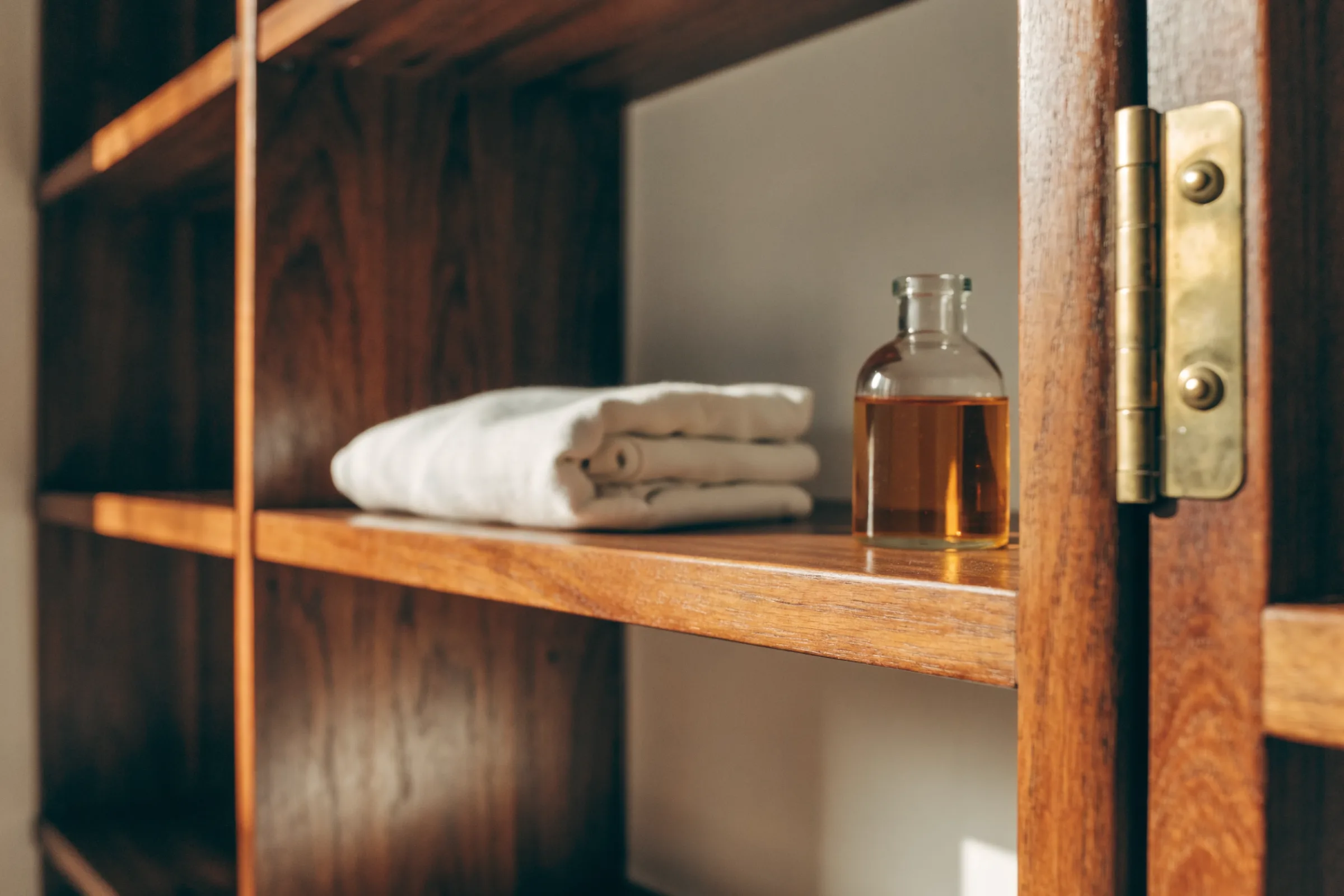
This is the routine we would hand over with every delivery if paper survived humid kitchens. It applies to solid wood, veneered and painted pieces alike, fitted or freestanding — in short, to the kind of work this routine keeps looking new.
The everyday: five minutes, a cloth, and water discipline
To clean wooden furniture, you need remarkably little. Dust with a soft dry cloth, microfibre or old cotton, working along the grain so anything gritty slides in the direction scratches show least. For actual grime, wring a cloth in warm water with a drop of mild dish soap until it is barely damp, wipe, then follow immediately with a dry cloth. Damp is a tool; wet is a mistake. The surface should never carry visible moisture for more than the seconds it takes you to chase it.
Spills are a now job, not a later job. Water, wine, sauce, it does not matter: blot it the moment you see it, because every finish buys you minutes, not hours. Under glasses and pots, the rule from the day of delivery is coasters and mats, and it is a far easier rule to keep than white rings are to remove. That is the entire daily programme. Wooden furniture maintenance is mostly the art of not creating work — and since one piece takes most of the daily risk, a dining table's own protection routine has a guide to itself.
Once a month: walk the house with your hands
Set a day, first Sunday works, and give every wooden thing thirty seconds of attention. Open and close each door and drawer: they should move the way they did last month, and a change is information. Try the handles and knobs; a loose one takes ten seconds with a screwdriver now and strips its thread if it waits half a year. Look at hinges for the fine black dust that says metal is wearing on metal, and at drawer runners for the same. Press gently on joints that take load, chair rails, table legs, shelf supports; nothing should flex or creak that did not before. Knowing what good hardware looks like when it is new makes the monthly comparison easier.
Fitted pieces get the same pass plus a moisture check. To maintain wood cabinets properly, look where water lives: under the sink, around the dishwasher, along the kickboards, and at the wall side of anything built in. A swollen kickboard or a musty corner caught in month one is trivial; caught in month twelve it is joinery work. The same attention keeps hinges, runners and doors adjusted on fitted storage working like the day they were fitted, and matters double in the kitchen, where heat, steam and water gang up on the same square metres daily — the full care routine for wooden kitchen cabinets covers that room on its own.
Custom furniture & carpentry
Made-to-measure furniture and woodwork designed and built for your space, from single pieces to full fit-outs.
Explore serviceThe don'ts, and why each one is on the list
Most finish damage we see was cleaning. Abrasives, scouring pads and cream cleansers take the sheen off a finish one pass at a time, permanently. All-purpose sprays are formulated for glass and laminate, and the ammonia in many of them dulls lacquer; silicone polishes build a film that smears forever and complicates any future refinishing. Soaking is out, so are dripping mops against furniture feet, and a wet towel laid over a wooden edge to dry is a slow chemical experiment on someone's work. If the mop question is really about the timber underfoot, the routine that keeps a timber floor alive here is its own, shorter discipline.
Two subtler ones. Heat: a pan, a teapot, even a laptop running hot for hours can cloud a film finish from below, so mats are not just for water. And unknown chemicals on unknown finishes: if you did not commission the piece and do not know what is on it, test any new product on a hidden face and wait a day. Finally, resist recreational polishing. A finished surface does not need feeding weekly; oiled surfaces have a renewal rhythm, film finishes need none at all, and more product is more often the problem than the cure.
Early warning signs worth acting on
Wood announces its problems early and quietly. A drawer edge that suddenly looks fatter, a door that rubs where it used to clear, a hairline crack that was not there in the last monthly pass. Whitening or clouding in the finish says moisture is under the film. A musty smell inside a cabinet, or grey-green speckling, says mould has found still air — how to clear mould from a wardrobe and keep it out picks that one up from exactly here. Hardware that loosens again soon after tightening says the screw hole, not the screw, is the problem. And a knock that sounds hollow where it used to sound solid, fine pellet dust under a cabinet, or a scatter of insect wings on a shelf is a different family again: reading possible termite signs on built-in furniture covers what each of those means, and who does what about it.
None of these are emergencies, and several are seasonal visitors that leave on their own. The swelling-and-sticking family in particular has a climate logic of its own, covered properly in the humidity-specific symptoms and their first response — the short version is: improve the room's air before you touch the wood, and give it time. What the signs above earn is attention on a shorter cycle. Watch weekly instead of monthly, and it will quickly show itself as either weather or wear.
When to call a carpenter
The honest sorting is into three piles. Adjustment: hinges out of line, a catch that misses, a runner that needs realigning, a handle re-seated. These are screwdriver jobs, and a careful owner can do most of them; the craft is knowing to turn the adjuster screws a quarter-turn at a time. Repair: anything structural — an open joint, a split panel, a swollen edge that stayed swollen through a dry season, veneer lifting at a corner. Here amateur fixes tend to add glue where glue is not the problem, and each attempt makes the eventual proper repair harder. Refinish: when a film finish is failing across a whole surface, clouded, cracked or peeling rather than scratched in one spot, no cleaning product is coming to help; the surface needs to be taken back and rebuilt by someone with the tools to do it flat.
The general rule a carpenter would give you over coffee: if the fix is metal, try it; if the fix is wood or finish, get an opinion first. A short description and a couple of photographs are enough for any competent workshop, ours included to tell you which pile your problem belongs to and what doing it properly involves. Asking costs nothing and commits you to nothing, and it is a far smaller embarrassment than the one the glue bottle causes.
Related guides
- Kitchen assembly & installation
How to care for wooden kitchen cabinets in a humid climate
How to care for wooden kitchen cabinets in a humid climate: grease and steam cleaning, sink-zone checks, ventilation habits, and swollen-edge warning signs.Read the guide - Custom furniture & carpentry
How to protect a wooden dining table from water, heat and daily use
How to protect a wooden dining table: first response to water rings and heat marks, coaster and mat habits, scratches, sunlight, and when refinishing is due.Read the guide - Custom wooden doors & gates
Wooden doors in humid weather: sticking, movement and adjustment
Why wooden doors stick in humid weather, which sticking fixes itself after the rains, how to find the rubbing point, and what you can adjust yourself.Read the guide
Related services
Custom furniture & carpentry
Made-to-measure furniture and woodwork designed and built for your space, from single pieces to full fit-outs.
Explore service
Built-in wardrobes & cabinets
Built-in wardrobes, closets and storage cabinets that use every centimetre. Measured, built, and installed.
Explore service
Tell us what you need built or installed.
Send a few photos and measurements — we'll get back to you with next steps.