
Termites and built-in furniture: what to watch for, and who does what
Published by Chaingkiat & Furniture — Nearly 30 years of hands-on carpentry, with our own workshop and crew on Koh Samui. · · 9 min read
In this part of the world, the question is never whether there are termites nearby. A review by Thai entomologists records more than two hundred species across the country and ranks them among the most common structural pests, feeding on building timber and furniture alike. The question that matters for your woodwork is quieter: whether anything has found a way in from the ground or a damp wall — and whether you would notice in time. With freestanding furniture, you usually would. With built-ins, the honest answer is: not without knowing where to look.
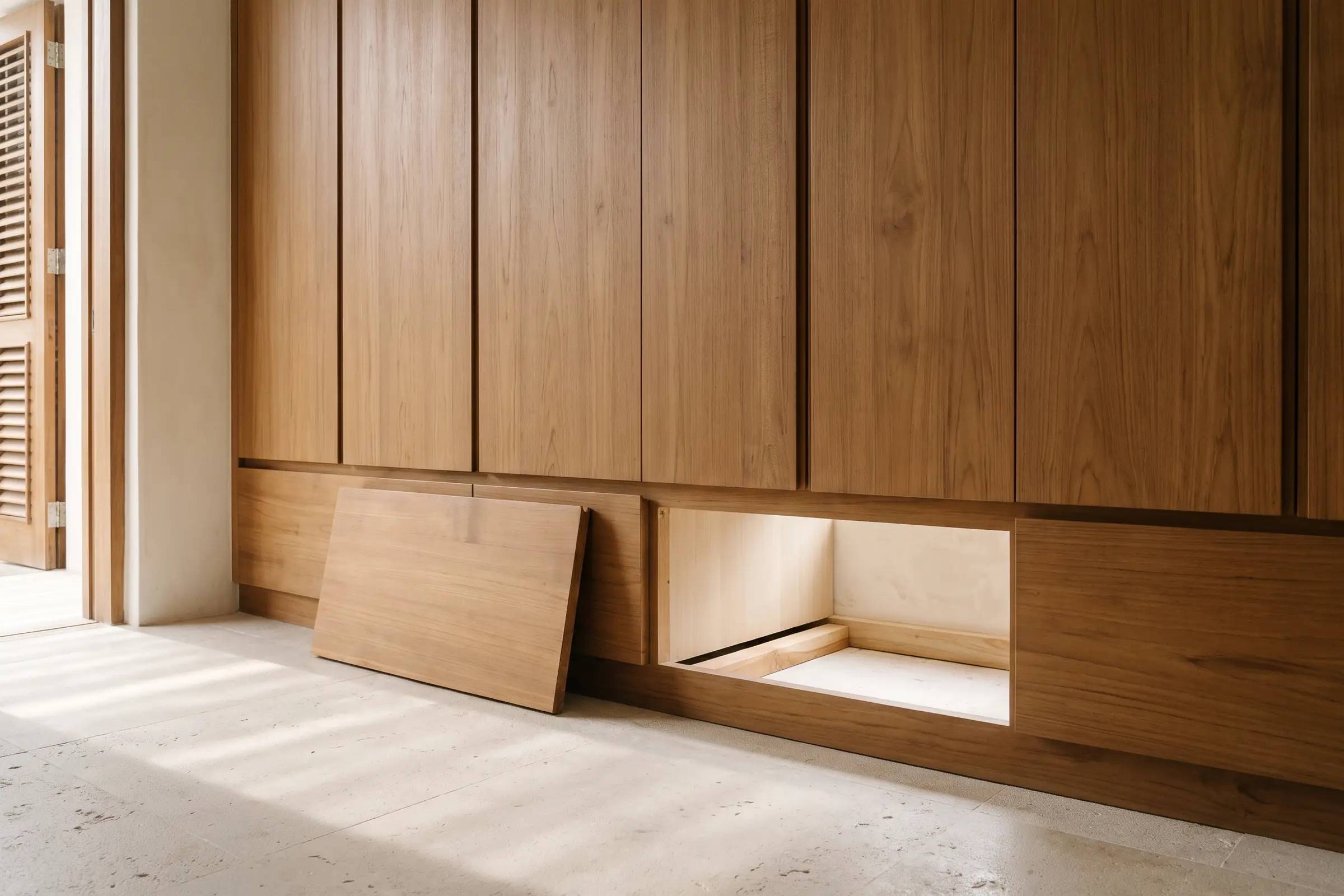
We are a carpentry workshop, not a pest-control company, and this guide keeps deliberately to the carpenter's half of the subject: how to read the signs on fitted woodwork, which of them call for a specialist before anyone touches a panel, and what a workshop that builds and repairs woodwork every week can honestly do about the damage once the colony itself has been dealt with.
Why termites and built-ins find each other
Termites are hidden animals. The extension entomologists who write the standard inspection guidance describe them as working out of sight almost by definition: subterranean species travel inside walls and timber and stay invisible until they swarm or until damage finally shows, and the drywood kinds spend their whole lives inside the wood they eat. None of that is unusual or a reason for alarm — it is simply how the insect works, and it decides how inspection has to work too.
A freestanding sideboard can be pulled out, tipped over and looked at from six sides in two minutes. Fitted work cannot. A kitchen run, a study wall of shelving or wardrobes fitted wall to wall and floor to ceiling close their own frames, the wall behind them and a strip of floor away behind fixed panels, often for years at a time. That is the tension at the heart of our own trade: the better a built-in fits, the less of it anyone can see. It is also why a habit of occasional, deliberate inspection matters more for fitted furniture than for anything that stands on legs.
Damp, mould or insects: read the symptom first
Most termite scares we are asked about turn out to be moisture. Humid-season movement has a rhythm of its own — doors that stick in the wet months and free themselves in the dry, edges that plump up and settle back — and swelling and sticking that tracks the seasons is climate, not insects. Grey-green speckling and a musty smell inside closed storage is the other regular suspect, and the playbook for mould in closed storage handles that one on its own.
Insect damage reads differently. It is local rather than seasonal: one plinth, one frame, one stretch of skirting, while identical panels a metre away stay perfect — and it does not ease when the air dries. The two problems are still related, because the inspection guidance is blunt about moisture: colonies that establish above ground need a constant source of it, usually a leak or permanently damp masonry. The damp that swells your doors is the same damp that makes a wall worth colonising. Fixing moisture is not a separate subject from termites; it is the first page of this one.
The signs, one at a time
The clearest sign is the mud tube: a dry, earthen tunnel about the width of a pencil, climbing from floor level onto timber. Extension services describe these as the classic evidence of subterranean termites bridging from the ground to the wood they are working. On fitted furniture, look for them at plinths, inside the kick space, at the back corners of carcasses and along the lines where panels meet masonry. The second sign is sound. Termites eat timber from the inside and leave the surface intact, so wood can be badly tunnelled and still look flawless; the standard field test is tapping along it with something hard — a screwdriver handle does fine — and listening for the dull, papery note of a hollow where the sound should be solid.
Surfaces talk too. Paint or lacquer that blisters, darkens or sags over sound-looking timber can mean galleries just beneath; an edge that crumbles under a thumbnail, or veneer lifting at the foot of a unit standing on a floor with a damp history, deserves opening up rather than a guess. In that position the cause can as easily be water as insects, and the response to both starts the same way: look inside before deciding anything.
Two more signs are about what falls out rather than the wood itself. Drywood termites push droppings out through holes smaller than two millimetres, leaving little cones of dry, granular pellets below; university pest guidance treats these six-sided pellets as that group's signature, while noting that pellets can keep trickling out of old, dead galleries — so pellets alone are a reason to inspect, not proof of a live colony. The same logic applies to swarmers. Winged termites at the lights on a humid evening, or a scatter of discarded wings on a sill or floor, mean a mature colony exists somewhere nearby: a reason to have the building looked at, not evidence that your furniture is the address.
The hidden zones behind built-ins
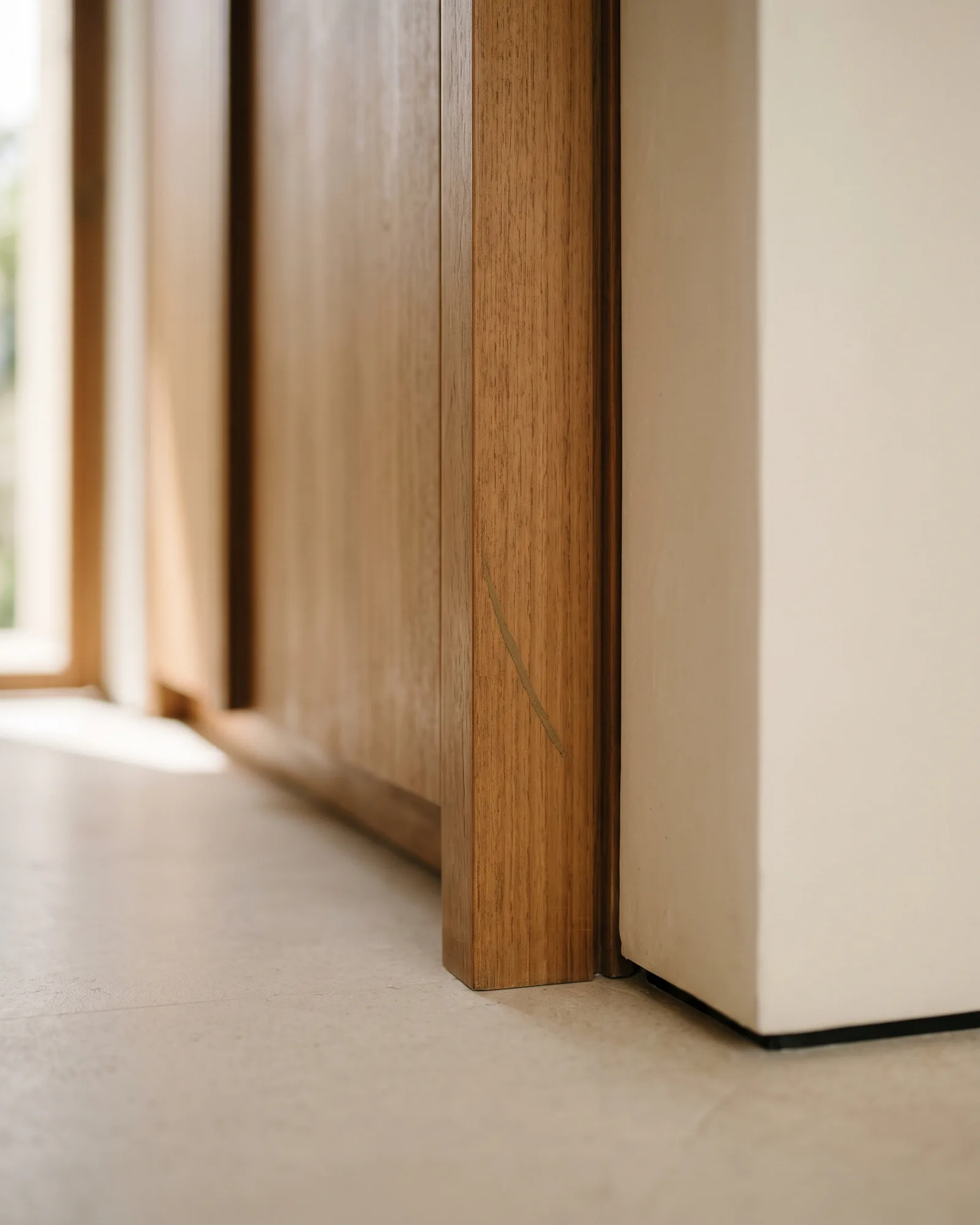
When we open up a fitted piece, the places we look first are the junctions nobody has seen since installation day. The back panel against an external or bathroom wall, where masonry damp can sit against timber for years. The plinth void where the cabinet meets the floor — the lowest, darkest, dampest pocket in the room. Any run that bridges wall and floor at once. Door and window frames that run down to floor level, which the inspection literature flags for the same reason. And outside the house, anything wooden touching the ground: extension guidance calls wood-to-soil contact a direct highway for subterranean termites, and a pergola post or deck bearer sitting in soil can be the bridge to woodwork indoors.
Keep moisture out, and keep a way in
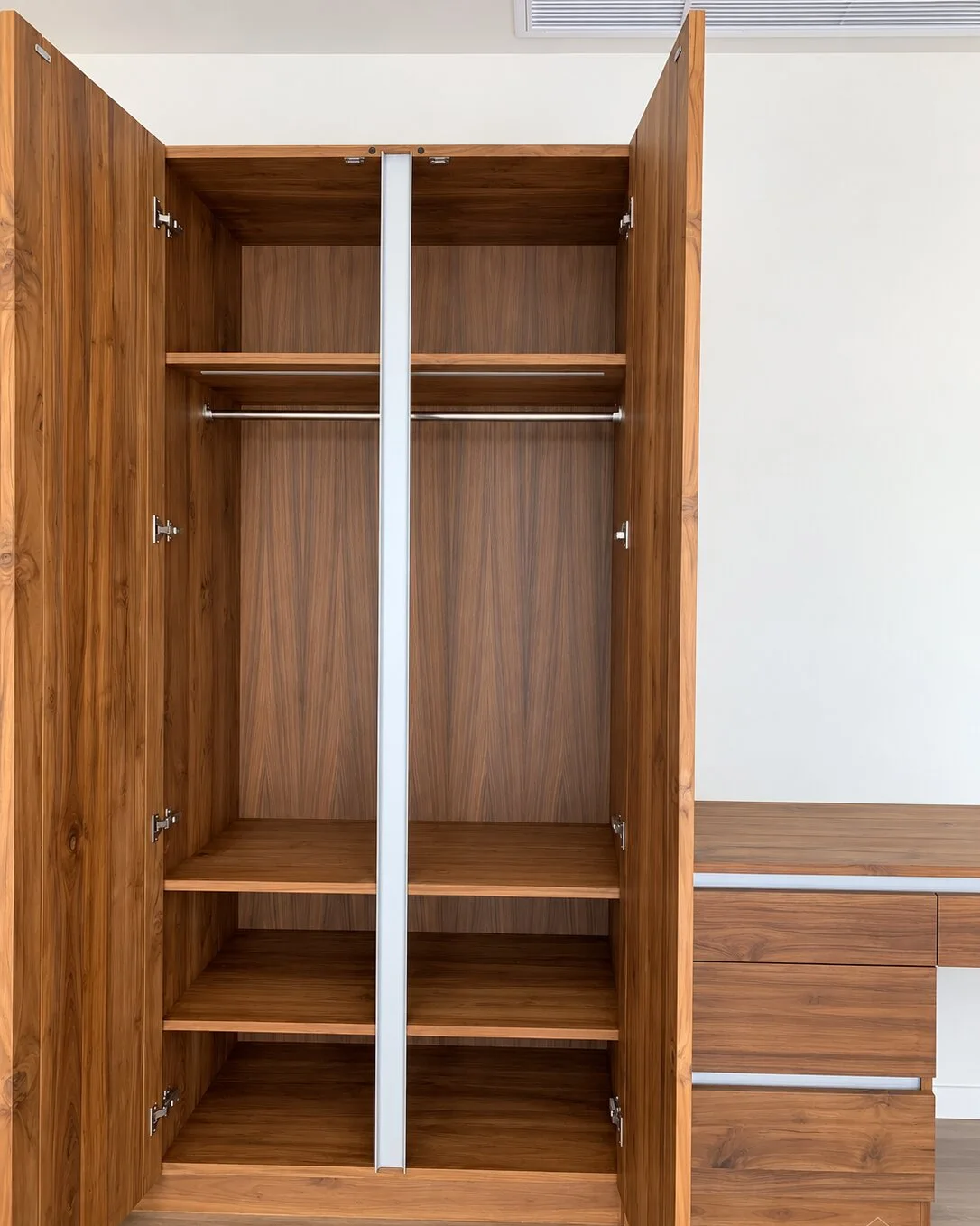
Prevention from the carpenter's side is two habits, not a product. The first is moisture discipline — the same routine that protects furniture from swelling protects it here: fix leaks when they appear, keep air moving through rooms and closed storage, and never let a cabinet sit pressed against a wall that stays wet. We will not re-teach that routine in this guide; the point here is a single one, which is that dry woodwork is poor real estate for a colony.
The second habit is access. On new work we treat inspectability as a detailing decision like any other: a plinth face that clips off rather than being glued shut, a back panel that can come away in one piece, a void a torch can actually reach. It costs little at the bench and turns a future inspection from demolition into ten minutes. If your existing built-ins have none of this, that is normal — most don't — and it simply means the first proper look may need a carpenter's hands rather than a torch alone.
Why filler and paint must wait
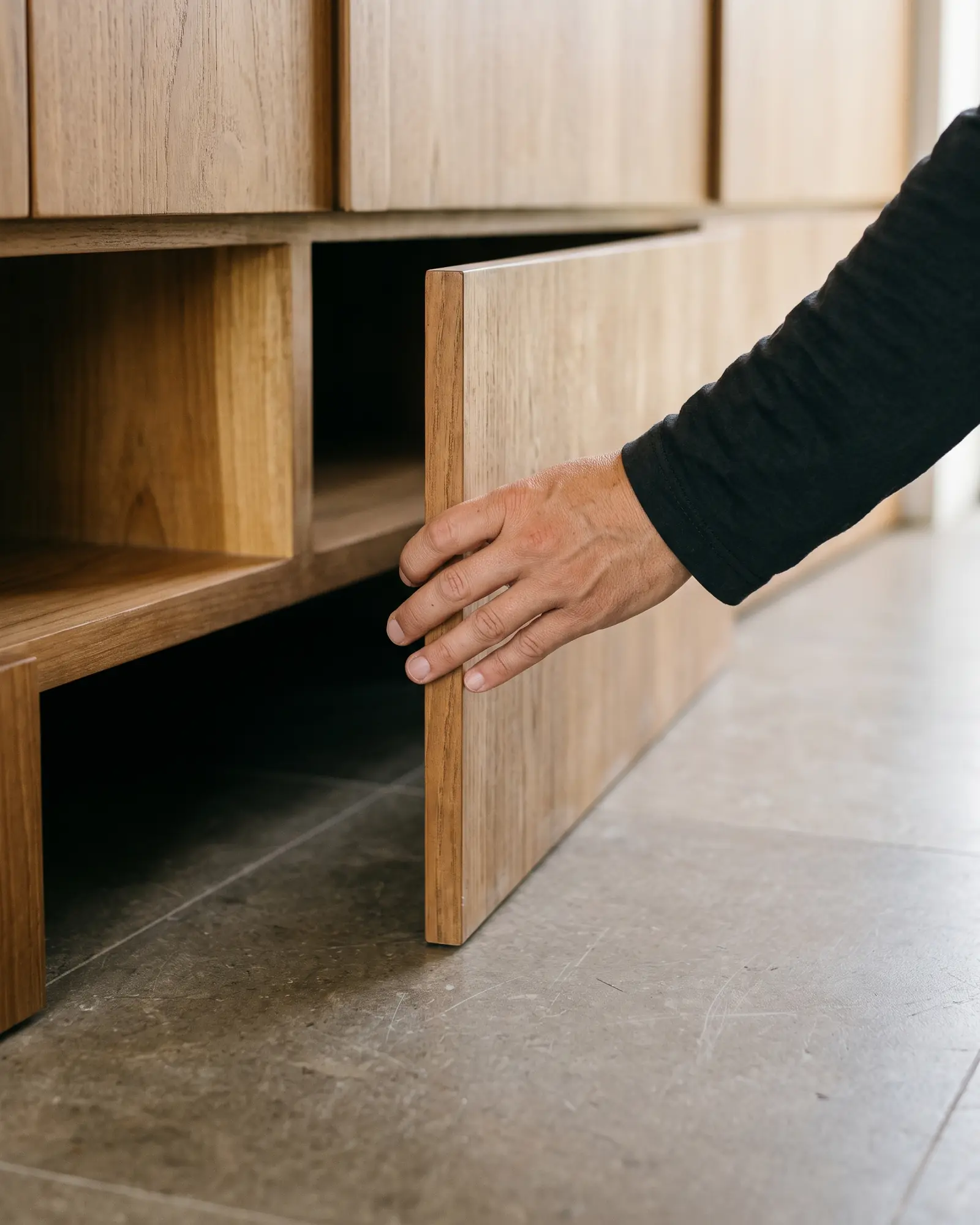
The tempting response to a crumbled edge or a blistered patch is to fill it, sand it and repaint: the room looks right again by the weekend. Done before anyone has looked inside, it is the single least helpful move available. Cosmetic filler hides exactly the evidence an inspection needs — where the galleries run, how far they reach, whether the frass is fresh — and if the colony is live, it keeps working behind the new paint, so the next time the problem surfaces it is larger. The order matters just as much with moisture: replace a panel against a wall that is still wet, and the replacement inherits the same conditions that fed the first failure. Inspection first, then the water, then the wood, and last of all the paint.
What a carpenter can honestly do
Our half of the job is the joinery. A carpenter can open up what was built closed: take off plinths and back panels, get light into voids, probe suspect timber, and map which parts of a unit carry structure and which are only skin. We can tell you whether what you are seeing looks like water damage, old dead galleries or wood that has simply failed — and we can say plainly when the pattern points past the furniture into the building itself, which is a specialist's territory, not ours.
Repair is ordinary workshop business — repairs and modifications to existing woodwork are part of what we do. Damaged components can be replaced without condemning the whole piece: a new plinth, a new back, a re-made shelf or door skin, fresh veneer over a sound carcass. Where a frame has taken the damage, a replacement door and frame made to the existing opening is often more honest than patching one that has been eaten hollow. And when a unit does have to be rebuilt, the rebuild is the chance to detail it better than the original: the plinth raised clear of the floor on adjustable feet, no timber in contact with damp render, every face sealed, and voids a torch can reach next time.
Custom furniture & carpentry
Made-to-measure furniture and woodwork designed and built for your space, from single pieces to full fit-outs.
Explore serviceWhere our job stops: the specialist's half
Now the boundary, stated as plainly as we can manage. We are furniture makers; we are not a pest-control company and we do not pretend to be one. Diagnosis beyond the joinery — whether a colony is live, where it nests, what else in the building is affected — belongs to a licensed pest-control specialist, and so does every decision about treatment: building-wide measures, and any choice or application of pesticide, without exception. The university guidance says the same thing to homeowners: effective treatment is trained, licensed work, not a hardware-store errand. If the signs point to an active colony, the specialist comes first and the carpentry waits.
The sequence that works — and the one we ask clients to keep to — is: inspection, then the specialist's treatment if one is needed, then the moisture fix, and only then the joinery repair. Rebuilding first wastes good work; a repaired panel in an untreated building is simply the next meal. Once the specialist has signed off and the wall is dry, we rebuild what was lost. That part really is our job, and it is a satisfying one.
Handover day, and when to pick up the phone
Two short notes to close the practical side. If you are about to accept a new villa, the torch-and-tape hour in the snagging pass on furniture and joinery at handover is the natural moment to look for mud lines and hollow notes along with everything else on that list — it is far easier to raise them before signing than after. And for anything that surfaces later in a piece's life, the sorting of what deserves a professional visit lives in one place on this site: the care guide's rule for when to call a carpenter — a short description and a couple of photographs are enough for us to say which trade your problem belongs to.
Three questions we keep being asked
Is teak termite-proof? No — and be wary of anything sold as termite-proof. Teak heartwood is rated among the most durable commercial timbers, and the wood-science references describe it as resistant to termites: resistant, not immune, and the rating applies to the heartwood, not the paler sapwood. Resistance buys time and tolerance, never immunity. How each species handles this climate covers the species question in the depth it deserves.
Do wings on the floor mean my built-ins are infested? Not by themselves. Swarmers fly from a mature colony somewhere nearby, and most of them die without founding anything. What a drift of wings earns is an inspection of the building — walls, floors, frames — with the furniture examined as part of it, not a panic about one wardrobe.
Can a termite-damaged built-in be repaired, or is it a write-off? Usually it can be repaired, once the specialist's work is done and the moisture is fixed. The deciding question is which parts carry load: eaten shelf edges, plinths, backs and door skins are all replaceable components, while a carcass whose structural members have been hollowed is a rebuild. Either answer is an ordinary quotation — and either is better than filling and hoping.
Related guides
- Custom furniture & carpentry
How to care for custom wood furniture: a practical maintenance guide
A practical care routine for wood furniture: cleaning that doesn't strip the finish, hardware checks, early warning signs, and when to call a carpenter.Read the guide - Built-in wardrobes & cabinets
Stopping mould in wardrobes and closed storage
Why mould grows inside wardrobes and closed storage in humid climates, and how to stop it: airflow, moisture sources, finishes, and when to rebuild.Read the guide - Custom furniture & carpentry
Snagging furniture and joinery at villa handover
What to check on furniture and joinery before signing off a villa: door and drawer alignment, hardware, worktop joints, finishes, moisture signs and timing.Read the guide
Tell us what you need built or installed.
Send a few photos and measurements — we'll get back to you with next steps.