
What wood survives a humid coastal climate?
Published by Chaingkiat & Furniture — Nearly 30 years of hands-on carpentry, with our own workshop and crew on Koh Samui. · · 7 min read
Ask what wood survives year-round humidity and you will usually get a one-word answer: teak. It is half right. The full answer is a chain of decisions — species, cut, board type, construction, finish — and a piece fails when any link is wrong, not just the first one. This guide walks that chain the way a maker does when choosing materials for a commissioned piece, one decision at a time.
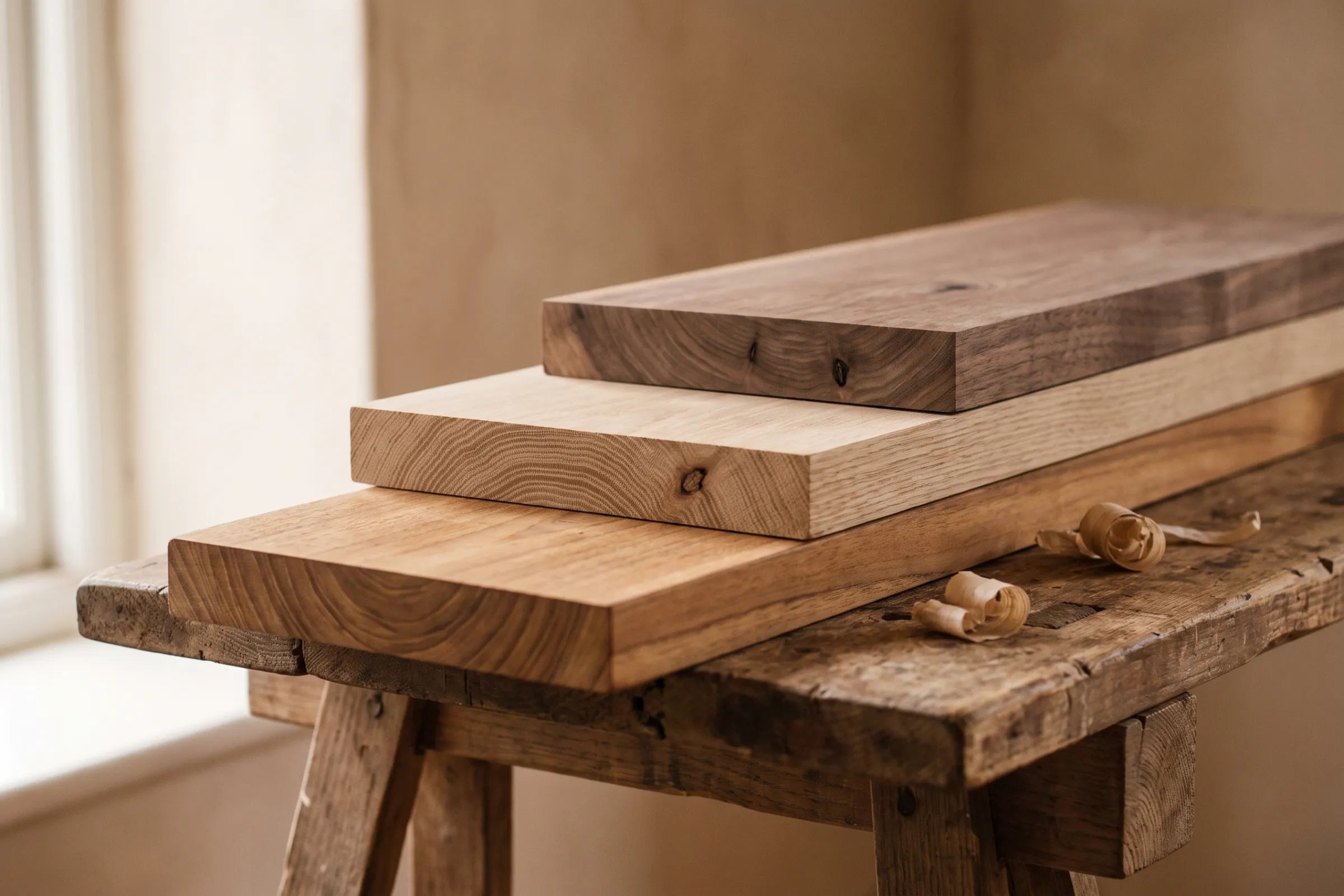
None of it is secret knowledge, and it will not make you a cabinetmaker — but it will let you read a quote, question a material spec, and recognise honest work, whoever ends up building for you.
What humidity actually does to wood
Wood never stops being a plant. It takes moisture from the air when the air is damp and gives it back when the air is dry, and it changes size as it does — swelling as it absorbs, shrinking as it releases. The movement is wildly uneven: along the grain a board barely changes; across the grain it moves enough to see and measure. A wide tabletop grows and shrinks across its width through the year; its length stays put. Every joint, panel and door has to be designed around that fact.
In a humid coastal climate the air stays damp most of the year, so you might expect less movement, not more. The complication is air-conditioning. A bedroom dried hard every night and left to re-humidify every day cycles its furniture constantly, and cycling — not dampness itself — is what works joints loose, cups panels and binds doors. This is also why the cut of a board matters: quartersawn timber, with the growth rings standing perpendicular to the face, moves roughly half as much across its width as an ordinary flatsawn board and stays flatter while it does. Makers reserve it for wide panels and doors for exactly that reason.
Why teak earned its reputation
Teak's standing is not marketing; it was earned over centuries of shipbuilding and verandah furniture. The heartwood carries natural oils and resins that shrug off water and deter insects, plus silica that hardens it against wear, and the timber is unusually stable — it moves less with moisture change than most hardwoods and tolerates the swing gracefully. It is one of few woods that can live outside unfinished, weathering to silver-grey instead of failing.
The honest version of the story has a second half. The old reputation was built on slow-grown, old-growth trees. Most teak sold today is plantation-grown, and plantation teak varies: faster growth means wider sapwood, less oil and a milder version of every property above. It can still be excellent, but the word on the label guarantees little by itself. Grade, heartwood content and proper drying matter more than the species name, which is why a maker inspects boards rather than trusting labels.
Other hardwoods that behave well in the tropics
Teak is not alone. Across tropical Asia there is a long tradition of dense local hardwoods used for houses and furniture precisely because they cope: species with natural oils, tight or interlocked grain, and enough density to slow moisture exchange down. What they share matters more than their individual names — heartwood rather than pale sapwood, which drinks moisture and invites insects; proper kiln drying rather than a quick air-dry; and a track record in furniture, not just in structure.
Imported temperate hardwoods — oak, ash, walnut — are not disqualified. Indoors, dried to the conditions they will live in and sensibly finished, they perform well and bring figure and colour the local palette lacks. They simply move more than the oily tropical species, so the construction must give that movement somewhere to go. Two cautions apply across the board: very oily timbers can resist glue and some finishes, and any species, however noble, fails if it goes into a piece still wet from the yard.
Engineered boards, done honestly
Sheet materials deserve a fairer conversation than they usually get. Plywood, MDF and particleboard are not one material at three prices — they differ in core, glue and how they fail. Moisture-resistant grades of MDF and particleboard use adhesives that tolerate humid air; marine-grade plywood adds waterproof glue lines and a core with no hidden voids. Standard board is not a scandal either: inside a conditioned room, in a well-built carcass, it serves for years. The grade has to match the exposure, and a quote that just says "plywood" or "MDF" has not yet told you anything.
Where boards actually fail is at the edges. Faces are sealed by their veneer or laminate; the cut edge is open end grain, and every unsealed edge, hinge bore and cut-out is a door left open to damp air. Edge-sealing every cut, including the ones hidden inside the carcass, is the single habit that separates board furniture that lasts from board furniture that swells. Veneered surfaces carry one more subtlety: veneer is real wood and still moves, so a panel needs a balancing veneer on its back face — veneer one side of a board and it will pull itself into a curve as the two faces exchange moisture at different rates.
Custom furniture & carpentry
Made-to-measure furniture and woodwork designed and built for your space, from single pieces to full fit-outs.
Explore serviceWhere solid wood belongs — and where it doesn't
Solid timber earns its place where furniture is touched, knocked and reshaped: tabletops, chairs, bed frames, carved and moulded work, and any piece you hope to sand back and refinish decades from now. But solid wood in width is solid wood in motion. A wide slab door in solid timber will try to cup and twist with every season, which is why traditional makers built frame-and-panel doors — a stable frame around a panel left free to move in its groove. The old construction is a humidity strategy, not a style.
For large flat surfaces — wardrobe doors, carcass sides, wall panels — veneered engineered board is often the genuinely better choice, not the budget one: the core stays flat where a glued-up solid panel would fight itself, and the face is still real wood. The same logic extends beyond furniture to timber surfaces on walls and ceilings, where big areas and fixed edges make stability worth more than thickness — our guide on why tropical villas put timber overhead covers that side of the craft. Good furniture mixes the two honestly: solid where hands and tools will reach, engineered where flatness must survive the seasons.
Finishes are the other half of the answer
No finish stops moisture; a finish slows it down, and slowing it is enough to soften the daily cycling that does the damage. Film finishes — lacquer, varnish, polyurethane — build a coat on the surface: the strongest brake on moisture, the easiest surface to wipe clean, but when they eventually crack or peel the repair is a full strip and recoat. Oil finishes soak in instead: less protection, more frequent care, but a worn patch is fixed with a rag and an hour rather than a refinishing job. Neither is right in general; a dining table and a wardrobe interior deserve different answers.
The rule that matters more than the product is coverage: seal all six faces. Backs, undersides and end grain that nobody sees still breathe, and a board sealed on its show face and raw on its back drinks from one side only — and that lopsided take-up, not bad luck, is what cups it. The maintenance reality is just as plain: every finish here is a schedule, not an event, and exposure sets how often it needs renewing. A sideboard in a conditioned room and a bench on a covered terrace live entirely different lives.
Salt air is a separate problem
Close to the sea, the thing that fails first is usually not the wood at all — it is the metal in it. Salt-laden air corrodes hinges, drawer slides, screws and handles long before a decent hardwood shows distress, and a seized hinge ruins a door as surely as a warped panel does. The fix is unglamorous: stainless steel fittings — stepping up a grade wherever the sea is in sight of the house — solid brass where the look suits, and a hard look at anything bright and zinc-plated.
How a workshop actually chooses
In practice, material choice starts with the room, not the timber rack. A bedroom cooled hard every night, an open living area that breathes with the weather, and a covered terrace facing the sea are three different environments, and the same piece would be specified differently for each. That is why a maker wants to see the space — or at least interrogate you about it — before naming a species or a board.
The quiet habits carry the rest. In a serious workshop, stock is checked with a moisture meter before it is worked rather than trusted by eye, and timber rests on site to acclimatise to the room's real conditions before final fitting. Construction is designed to let wood move instead of forbidding it to. None of this shows in a photograph, which is exactly why it is worth asking about — whichever maker you talk to, and whatever you decide about whether to buy or commission at all. The species question people start with turns out to be the last link in the chain.
Related guides
- Wooden ceilings & architectural woodwork
Why tropical villas use wooden ceilings
Why tropical villas use wooden ceilings: heat and acoustics, timber and batten options, and what installing one over a finished interior involves.Read the guide - Wooden ceilings & architectural woodwork
Planning interior woodwork: from measurements to installation
The sequence behind villa interior woodwork: survey and measurements, deciding the built-in elements, lighting, trade coordination, production, installation.Read the guide - Custom furniture & carpentry
Planning custom furniture for a Koh Samui villa
What to decide before commissioning custom furniture for a Koh Samui villa: materials for island humidity, measuring, and how the build and installation work.Read the guide
Related services
Tell us what you need built or installed.
Send a few photos and measurements — we'll get back to you with next steps.