
Wood floor maintenance in a tropical climate
Published by Chaingkiat & Furniture — Nearly 30 years of hands-on carpentry, with our own workshop and crew on Koh Samui. · · 4 min read
A wood floor is furniture you walk on. Everything that threatens a table threatens it too, plus sand in every sandal, sun through every doorway, and mopping water by the litre. Yet a floor asks for surprisingly little; the trick is knowing which enemy you are dealing with, because they work at very different speeds.
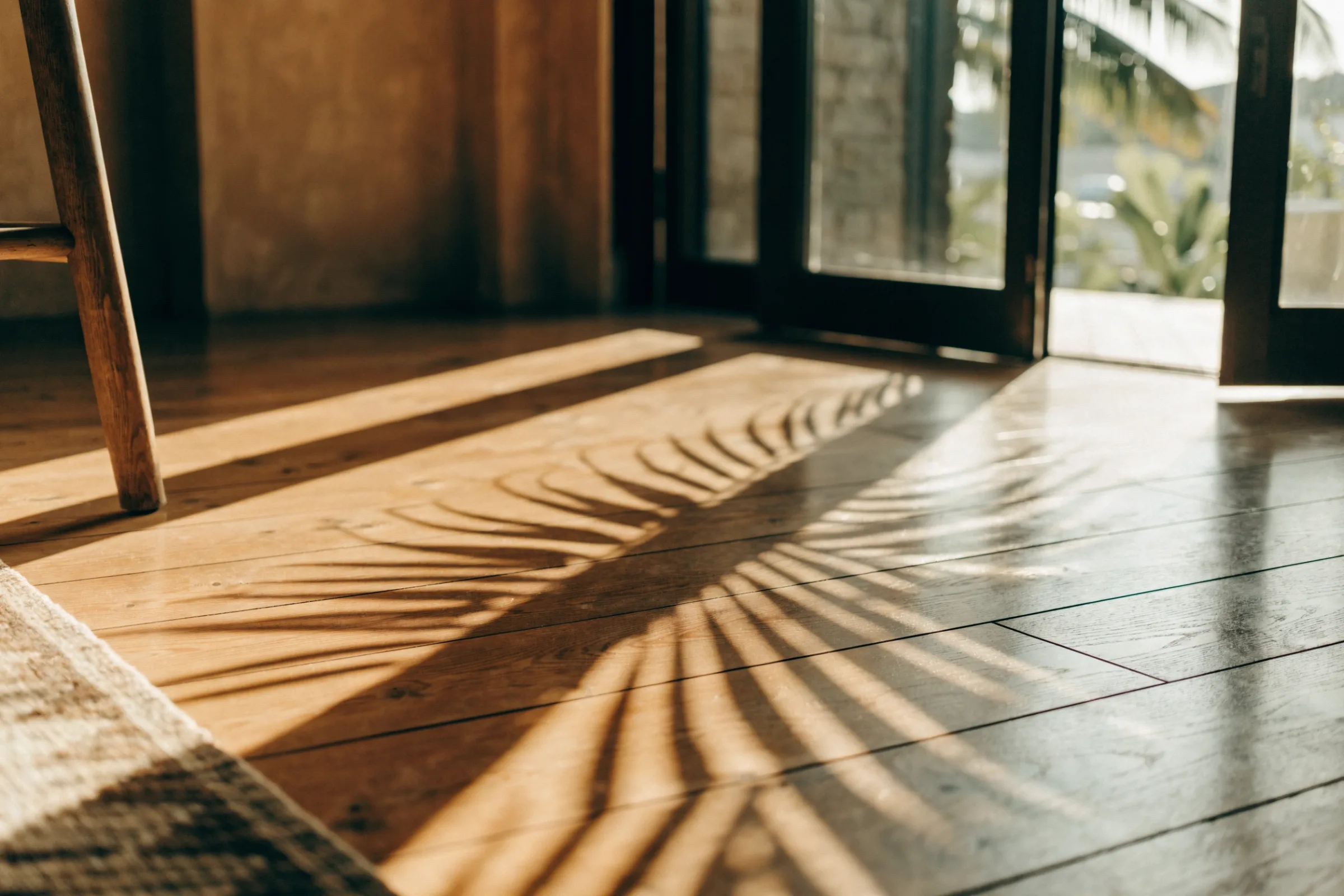
That is how this guide is arranged: by timescale. Some damage happens in minutes, some over days, some across months and seasons. Sort the threats by their clock and the maintenance sorts itself. Everything here is aftercare for a floor you already have, whoever laid it — though the same climate logic shapes the made-to-measure woodwork we build for island houses.
Minutes: water that stands
The fastest damage is the wettest. A floor should be cleaned damp, never wet: a well-wrung mop or cloth, plain water or water with a little mild soap, and no puddles chasing the mop head. Water that pools finds the board joints, and joints drink from their edges, which is how a five-minute puddle becomes a permanently proud seam. The same clock runs under plant pots without saucers, around pet bowls, and inside the splash line of an open door in a storm — on Koh Samui a squall can put rain two metres into a room before anyone reaches the doors. Spills and blow-ins get wiped when they happen. That single habit outranks everything else on this page.
Days: grit is sandpaper with patience
Nothing dulls a floor finish faster than sand ground in underfoot, and in a beach climate the supply is endless. The defence is placement again: a mat outside every entrance and a rug just inside, shoes off if the household will wear it, and a soft-headed broom or brush-head vacuum a couple of times a week on the walk lines. Skip the beater-bar vacuum setting; it is designed for carpet and peppers a hard floor with fine scratches.
The other day-scale abrader is furniture. Felt pads under every chair and stool leg, checked twice a year because they wear through and fall off, and a lifting habit instead of a dragging one when things move. One dragged sofa does a season of sand's work in four metres.
Months: the sun draws on the floor
Leave a rug in one place for a year in a bright room and lifting it reveals its portrait: a sharp-edged rectangle where the boards kept their colour while everything around them faded, or darkened, depending on the species. Sun through open doors and big windows works on floors for more hours than on any piece of furniture. You cannot stop it, and mostly should not try, but you can make it even: rotate rugs a few times a year, shift furniture that never moves, and soften the harshest exposures with curtains or films during the fiercest months. An evenly sun-aged floor looks like character; an unevenly aged one looks like a mistake.
Seasons: movement and the gaps that let it happen
Every wood floor moves with the year. Boards take on moisture through the rains and give it back in the dry months, and the whole surface breathes wider and narrower as they do; the mechanism is the same one that moves every plank in the house, laid out in why boards move between seasons. A properly laid floor plans for this with expansion gaps at the walls, hidden under the skirting, which is why the perimeter matters: never caulk, fill or wedge those gaps shut, and never pack the edge tight with fixed furniture on both sides of a wide run.
Season-scale symptoms read accordingly. Hairline gaps between boards in the dry months that close again by the rains are the floor breathing, not failing; resist the urge to fill them in January only to watch the boards fight the filler in October. Slight cupping at the height of the wet season that relaxes afterwards is the same story. What you are watching for is movement that does not reverse, which belongs in the warning-signs list below.
Custom furniture & carpentry
Made-to-measure furniture and woodwork designed and built for your space, from single pieces to full fit-outs.
Explore serviceYears: the re-oiling cycle
Floors and decks wear their finish off with their feet, so unlike a cabinet, a floor has a renewal rhythm. What that rhythm is depends entirely on what is on the boards: an oiled interior floor wants feeding when water stops beading and the walk lines go dry and pale; an oiled outdoor deck asks far more often, and greying is its way of saying the last coat has given everything; a film-finished floor needs nothing for years, then needs a proper decision when the film starts wearing through in traffic lanes. Which finish is on your boards, and what its renewal actually involves, is the finish guide's territory — start with which finish a floor should be re-oiled or re-coated with before buying anything in a tin. The photographed teak decks and stairs our crew laid show what a fed deck looks like against the grey of a starved one.
The signs that outrank the calendar
Some floor signals should jump the queue whatever the season. Cupping or a proud seam that survives a full dry season. A soft spot or a board that gives underfoot. Black staining spreading from a wall, a doorway or a bathroom line, which is water arriving from below or beside, not from your mop. A gap that grows month on month in one place while its neighbours stay steady. All of these say the floor's conditions have changed, and the useful response is diagnosis rather than product. Stop the water if you can find it, then get an experienced eye on it; our care guide sets out who handles what, when a floor problem needs a craftsman's opinion.
Related guides
- Custom furniture & carpentry
How to protect wooden furniture in a tropical climate
How to protect wooden furniture from tropical humidity: placement, airflow, finishes that seal, aircon habits, and the fixes for swelling and sticking.Read the guide - Custom furniture & carpentry
How to care for custom wood furniture: a practical maintenance guide
A practical care routine for wood furniture: cleaning that doesn't strip the finish, hardware checks, early warning signs, and when to call a carpenter.Read the guide - Custom furniture & carpentry
Oil, varnish or polyurethane? Choosing the right finish for wood
Oil, varnish or polyurethane: how each finish behaves on furniture in a humid climate, what repairs look like later, and how to choose for each surface.Read the guide
Tell us what you need built or installed.
Send a few photos and measurements — we'll get back to you with next steps.