
Which kitchen worktop survives a coastal climate?
Published by Chaingkiat & Furniture — Nearly 30 years of hands-on carpentry, with our own workshop and crew on Koh Samui. · · 9 min read
Kitchens do not fail in the middle of the worktop. They fail at the holes and the edges: the sink cut-out, the joint between two sections, the line where the top meets the wall, the front edge where a cloth gets wrung out. Worth knowing before choosing a material, because most worktop comparisons are written about the middle of the slab, where almost nothing ever goes wrong.
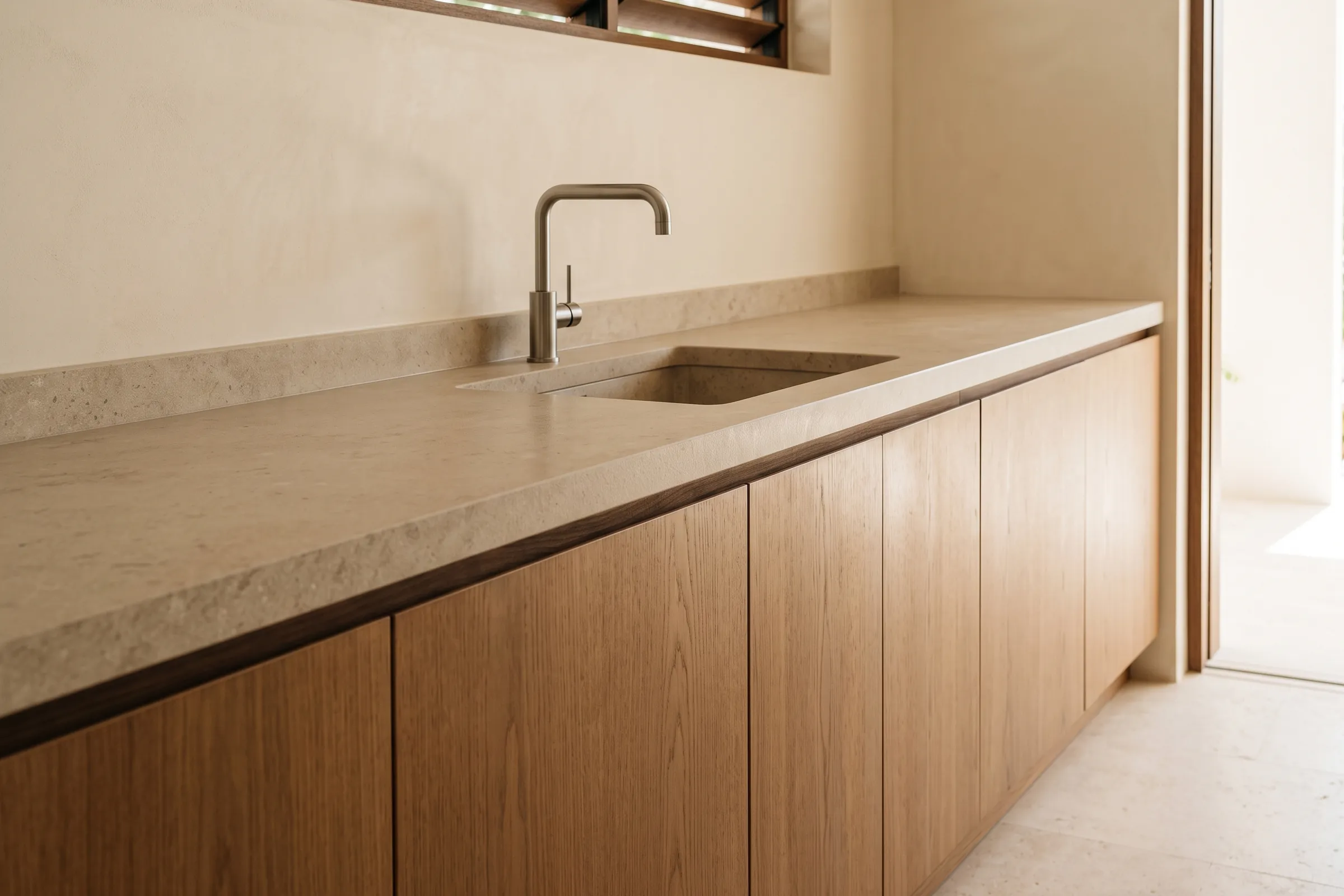
This page is about the choice itself and about the thing underneath it. Coastal air does not attack a worktop the way it attacks a timber door, so the real question is less what survives humidity and more what survives water collecting wherever the surface is interrupted. fitting the cabinets a worktop has to sit on is our half of the job, and the cabinets turn out to matter more to the outcome than the material on top of them.
One surface, four jobs
A worktop is the only surface in a house asked to take standing water, direct heat, blades and the weight of somebody leaning on it, in the same square metre, every day. A floor takes water and weight but no knives. A dining table takes heat but no plumbing. That combination is why worktop materials get compared on so many axes at once, and why none of them wins outright.
Two of those axes get heavier here. Air that sits close to saturation for much of the year means a surface rarely dries fully on its own, so anything that wicks water keeps wicking rather than recovering overnight. Salt in the air sharpens every question about metal, including the sink and the fixings under the top.
The contenders, one at a time
Six materials cover almost every kitchen quoted on Koh Samui. Each is taken the same way: water, heat, repairability, upkeep, and the honest case for and against.
Granite and other natural stone
Stone is indifferent to humidity in itself. It is rock and it does not swell. The variable is porosity. Polished granite is dense and takes an impregnating sealer well; softer, more open stones drink. A sealed top shrugs off a spilled drink, and the same top with a worn sealer takes a ring from it. Oil marks are worse than water because they darken instead of drying. Sealing is a habit on a cadence, not an event, and the cadence depends on the stone and on how hard the kitchen works.
Heat is where stone is genuinely good, which is why it ends up in kitchens where somebody cooks seriously. Against it: weight, the support it needs, and a chip in a square edge being a visible repair. Every joint stays a line you can see and one that has to stay sealed.
Engineered quartz
Resin-bound quartz is non-porous, which makes humidity a non-event and staining close to one. It needs no sealing, wipes clean, and holds a consistent colour across sections in a way natural stone cannot. For most coastal kitchens it is the low-maintenance default, which is a perfectly good reason to choose it.
Its limits are heat and light. The resin that makes it non-porous is what scorches under a pan taken straight off the flame, and strong direct sun over years shifts some shades, which matters in a room with a wall of glass facing the water.
Solid surface
Solid surface sheet is the one material whose joints disappear, because sections are bonded and then sanded flush. In a wet room that is a real advantage: a seam you cannot see is a seam water cannot sit in. Scratches and light marks sand out, so the surface can be brought back rather than replaced.
It is softer than stone, marks more easily, and will not take a hot pan at all. Its other advantage deserves naming: an integrated bowl means no rim, no sealant line and nothing for water to work under at the one place water is guaranteed to be.
Laminate sheet
The honest case for laminate is that it is cheap, available, and in a kitchen that is not cooked in hard it looks good for a long time. The case against it is specific rather than snobbish: the decorative face is waterproof and the board core behind it is not, so water that gets past the face swells the core, and a swollen core never comes back down.
Laminate therefore lives or dies at its interruptions. The sink cut-out, the joint strip between lengths, the front edge where a cloth is wrung out, the back edge at the wall: each is a cut through the face into the core, each needs sealing, and the sealing needs keeping up. In a villa that lets, with cleaners rather than owners at the sink, that is a promise nobody keeps. In an owner's kitchen it can be a sound choice.
Solid timber
Timber is the only top on this list that is still alive. It moves with the season, it needs an oil film kept up, and it will mark. It is also the only one you can sand back to new decades later. Because that decision differs in kind from the others, it gets its own section below.
Stainless steel
Stainless is the professional answer: unbothered by water or heat, hygienic, and it takes an integrated bowl without a joint. Its weaknesses are aesthetic rather than technical. It scratches into a patina almost immediately, shows every fingerprint, and is loud and cold under the hands.
Within sight of the sea the grade is the whole question, because chloride in the air pits the lower grades into rust freckles. Ask what grade is being supplied and what the supplier says about coastal exposure; a vague answer is itself the answer.
General material behaviour, not a product specification
How each worktop material behaves in coastal air
| Worktop material | How it behaves in humid coastal air |
|---|---|
| Granite and natural stoneUnaffected by humidity itself; porous stone stains where the sealer has worn, and oil marks darken rather than dry. | Needs its sealer kept up |
| Engineered quartzNon-porous and needs no sealing; direct heat and strong sun are its real limits, not water. | Indifferent to damp |
| Solid surfaceJoints are bonded and sanded flush, so there is no seam for water to sit in; it marks with heat. | Indifferent to damp, and repairable |
| Laminate sheetThe face is waterproof, the board core behind it is not, so every cut-out, joint and worn edge is the way in. | Fails at the interruptions |
| Solid timberNeeds an oil film maintained and end grain sealed; it is the only top that sands back to new. | Moves, and can be brought back |
| Stainless steelUnbothered by water or heat, but coastal chloride pits the lower grades, so the grade is the question to ask. | Depends on the grade |
Material behaviour, not an offer: we build and set out the cabinets and make the cut-outs. The tops themselves are templated and fabricated by a specialist.
Where coastal air actually bites
Nothing above fails because the air is humid. They fail where the surface is interrupted and the water has somewhere to go.
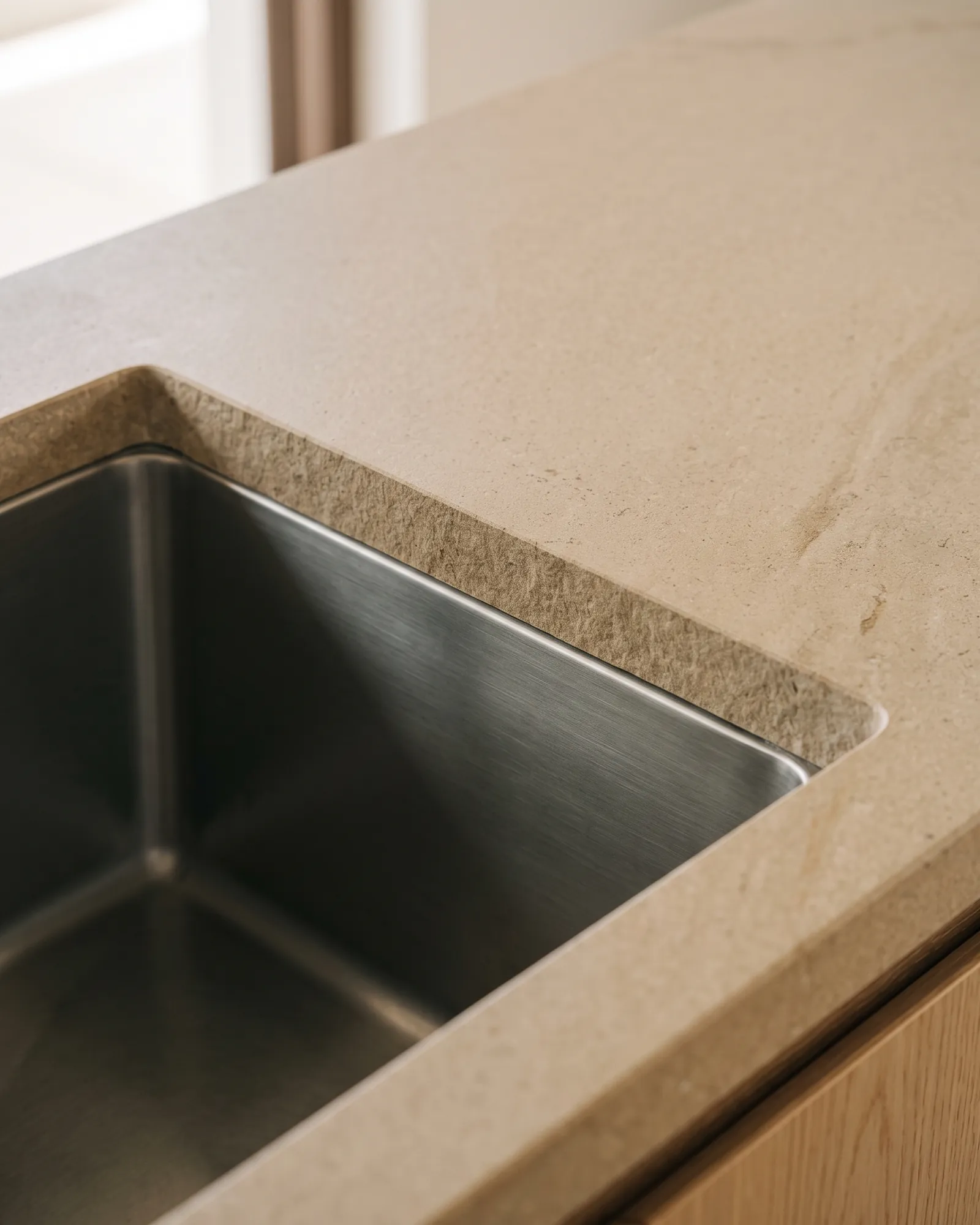
The sink cut-out comes first. It is a hole through the top, surrounded by the only part of the room wet by design, and on every option except a bonded or integrated bowl it depends on a bead of sealant holding for years. Look at it on handover, and again after the first wet season.
The splashback junction comes second. That line takes every splash a tap throws, and a thin patch in it routes water down the back of the cabinet, unseen until the kickboard swells. Third is the joint between sections, which should be tight, level across the seam and sealed; a joint set over a sink or hob cabinet rather than a solid run is placed at the worst available spot. The same detail fails in another room for the same reasons, which is why the other room where a sink meets a cabinet is written up on its own page.
Edges come last and matter more than they look. A square arris chips. A worn edge on a laminate top is an open core. On stone, the underside of an overhang is where a sealer never gets reapplied, because nobody looks there.
Solid timber as a working surface
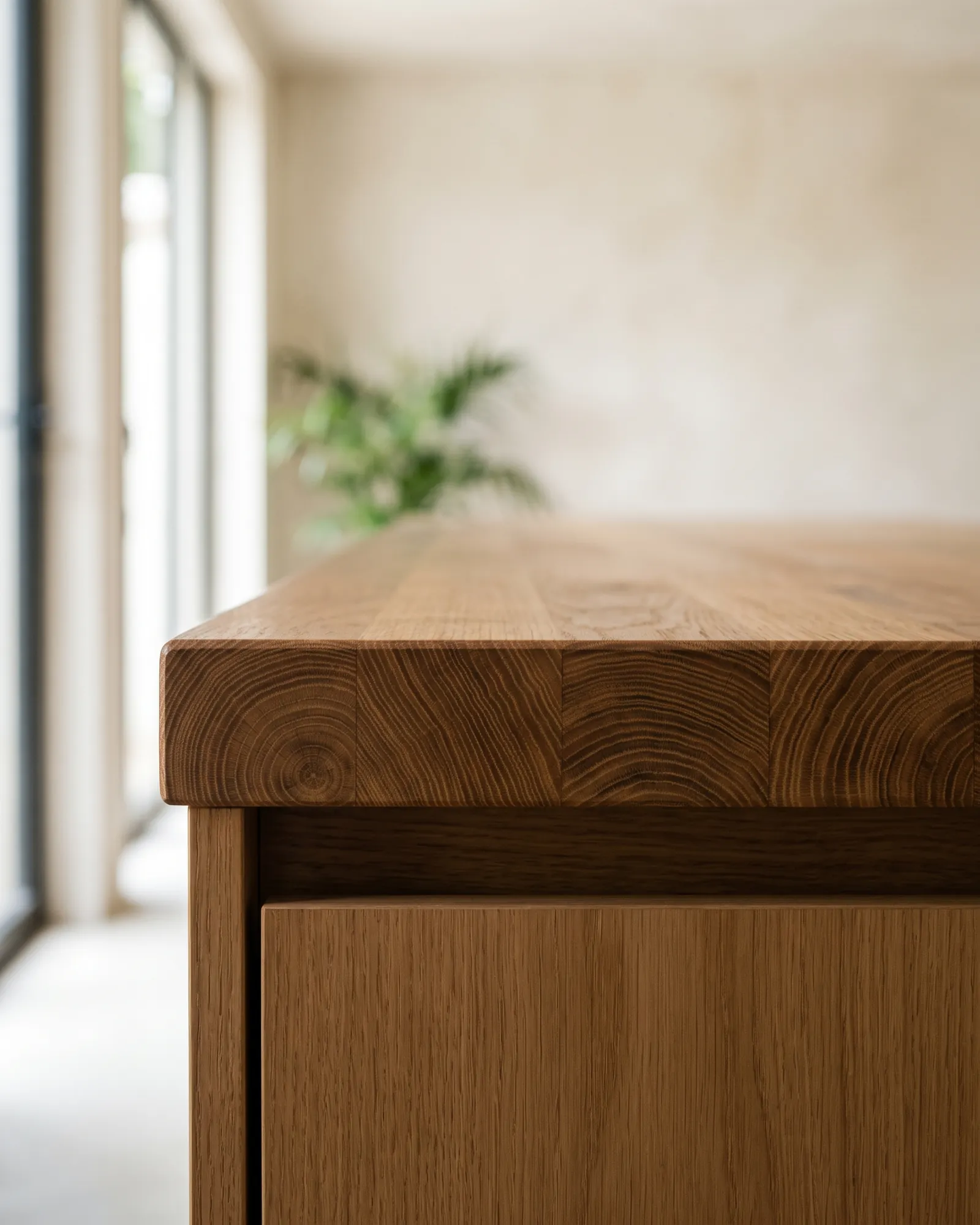
A timber top earns its place where the kitchen is cooked in by people who like wood and will maintain it, and where the wet zone is handled separately: an undermounted bowl in a stone or solid surface island, or a dedicated sink run, with timber on the dry stretches. Which timber, and whether solid or a thick engineered build-up, is a different argument settled on the timber and board decision underneath all of this rather than here.
What a timber top asks of you is specific. End grain around any cut-out has to be sealed properly, including on the underside where nobody looks. The oil film is a consumable, renewed on a cadence that is shorter beside a sink than at the far end of the run. Standing water raises the grain and, left long enough, blackens it where iron meets the tannin in the wood. oiling a timber top and re-coating it later covers the product side of that.
What it gives back is repairability nothing else here can match. A scorch, cut or stain is sanded and re-oiled locally, by the owner. A stone top with a chip keeps that chip for the rest of its life.
What the cabinets underneath have to do
This is the half of the subject that is actually ours, and it decides more outcomes than the material above it.
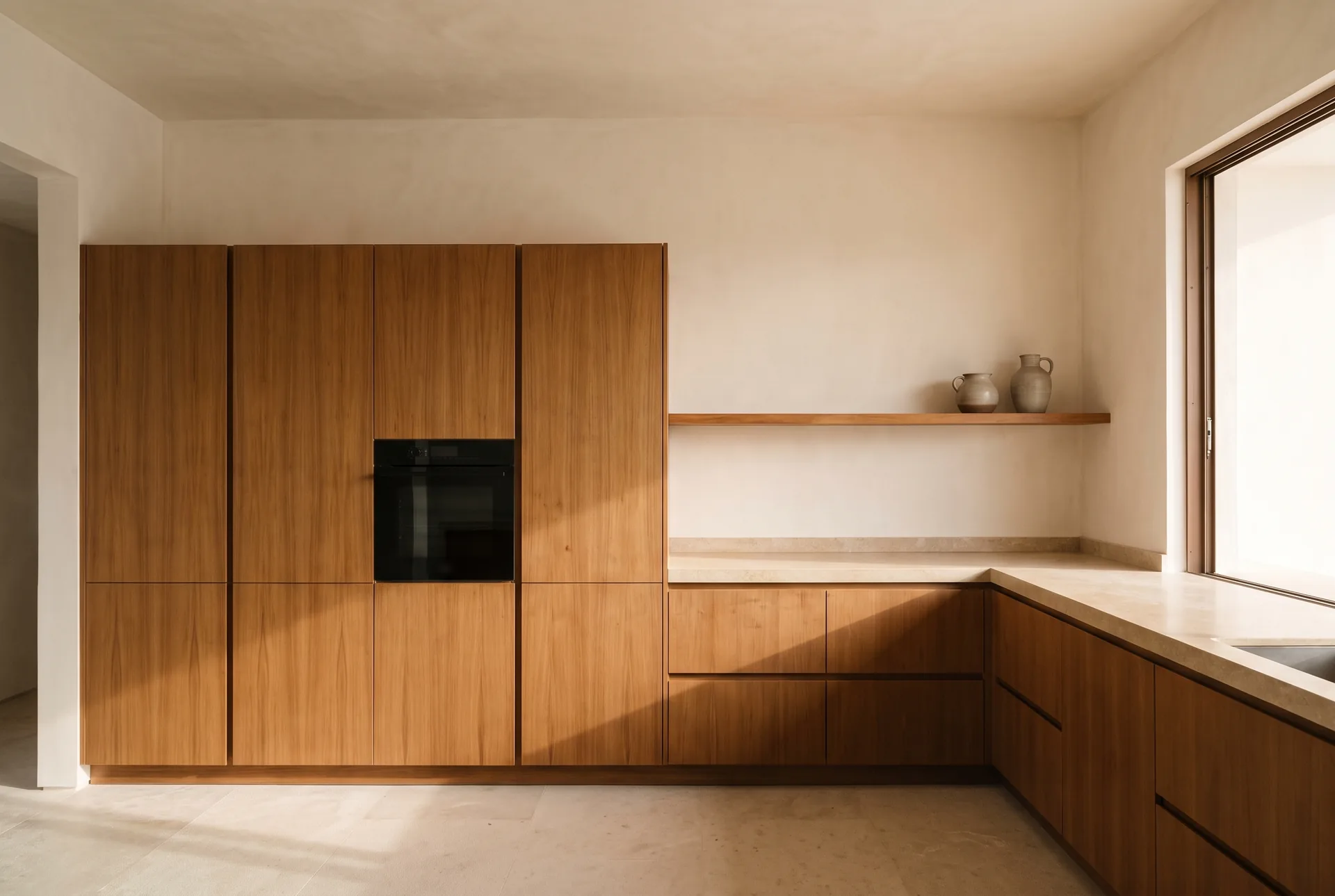
The cabinet run has to be dead level and in plane, because a stone or solid surface top is a rigid object that will not follow a wavy run. It will rock, bear on a point, or crack at a cut-out corner. Long spans need support where the fabricator asks for it, and cut-out corners need it more, because a cut-out is where a slab is weakest. Bringing a run true is a different exercise when the cabinets below came out of a box.
Every cut edge in the cabinet gets sealed before the unit goes in, and the sink cabinet is the one that proves whether a workshop does this. Its board is drilled for the waste, cut for the pipework and lives under the only guaranteed leak in the room. keeping the cabinets under a worktop dry is the aftercare half of the same point.
Then the parts nobody photographs: the kickboard standing closest to mop water, the back panel against a wall that may be an external one, and a fixing method that lets the top be lifted again one day without destroying the cabinets under it.
The schedule the top imposes
A worktop cannot be made until the cabinets are standing, fixed and level, because it is measured from them. Cabinets and top therefore never land on the same day, and a kitchen is two programmes stitched together rather than one. when a top gets templated in the install sequence places it in the order of work, and how the top's schedule folds into the whole project covers what that gap does to a delivery date.
Two practical consequences. Cut-out positions get confirmed against the actual sink and appliances rather than a model number on a drawing, so those items need to be on the island or at minimum fully specified. And the kitchen is unusable between the cabinets going in and the top arriving, which is worth planning around rather than discovering.
Kitchen assembly & installation
Kitchen cabinets and units assembled and installed — aligned, fixed, and finished ready for daily use.
Explore serviceChoosing honestly, including when the cheap option is right
Work from the room rather than from the material. Who cooks here, and how hard. Is this an owner's kitchen or a villa that lets. Will somebody put a hot pan down without thinking. Does anyone actually want to maintain a surface, or is the honest answer no.
From those answers the choice usually makes itself. A villa that lets wants a non-porous surface and no maintenance promise: quartz or solid surface. A serious cook who will keep a sealer up should have granite. Someone who wants timber and knows what it costs in attention should have timber on the dry runs and something else at the sink. A kitchen everyone understands is an interim one is a perfectly good laminate kitchen, and saying so beats talking somebody into a slab.
The failure to avoid is an expensive surface on a badly built base. A quartz top on a run that is out of level is a worse kitchen than a laminate top on a run that is true, and it costs several times as much to be worse.
Who does what
The line is worth stating plainly, because it is not obvious from outside. We build and set out the cabinets, bring the run level, make the cut-outs for sinks and hobs, seal the board edges before anything goes in, and coordinate the sequence so the fabricator's visit lands when it should. A stone, quartz or solid-surface top is templated and fabricated by a specialist. We do not supply those materials, we do not recommend one fabricator over another, and everything on this page about them is advice rather than an offer. Timber is the exception, because a timber top is wood built for your space like any other piece we make.
What we will do is tell you what each choice means for the cabinets under it, and build a base that does not embarrass a good top. worktops meeting cabinet runs in kitchens we fitted shows the junction this whole page has been about.
Related guides
- Kitchen assembly & installation
Planning a kitchen installation on Koh Samui, step by step
Planning a kitchen installation on Koh Samui: sequencing units, worktops and appliances, levelling on site-built walls, and choosing boards for coastal humidity.Read the guide - Kitchen assembly & installation
How to care for wooden kitchen cabinets in a humid climate
How to care for wooden kitchen cabinets in a humid climate: grease and steam cleaning, sink-zone checks, ventilation habits, and swollen-edge warning signs.Read the guide - Custom furniture & carpentry
What wood survives a humid coastal climate?
How teak, other hardwoods and modern boards cope with humidity and salt air: what swells, what lasts, and how makers choose materials for coastal homes.Read the guide
Related services
Kitchen assembly & installation
Kitchen cabinets and units assembled and installed — aligned, fixed, and finished ready for daily use.
Explore service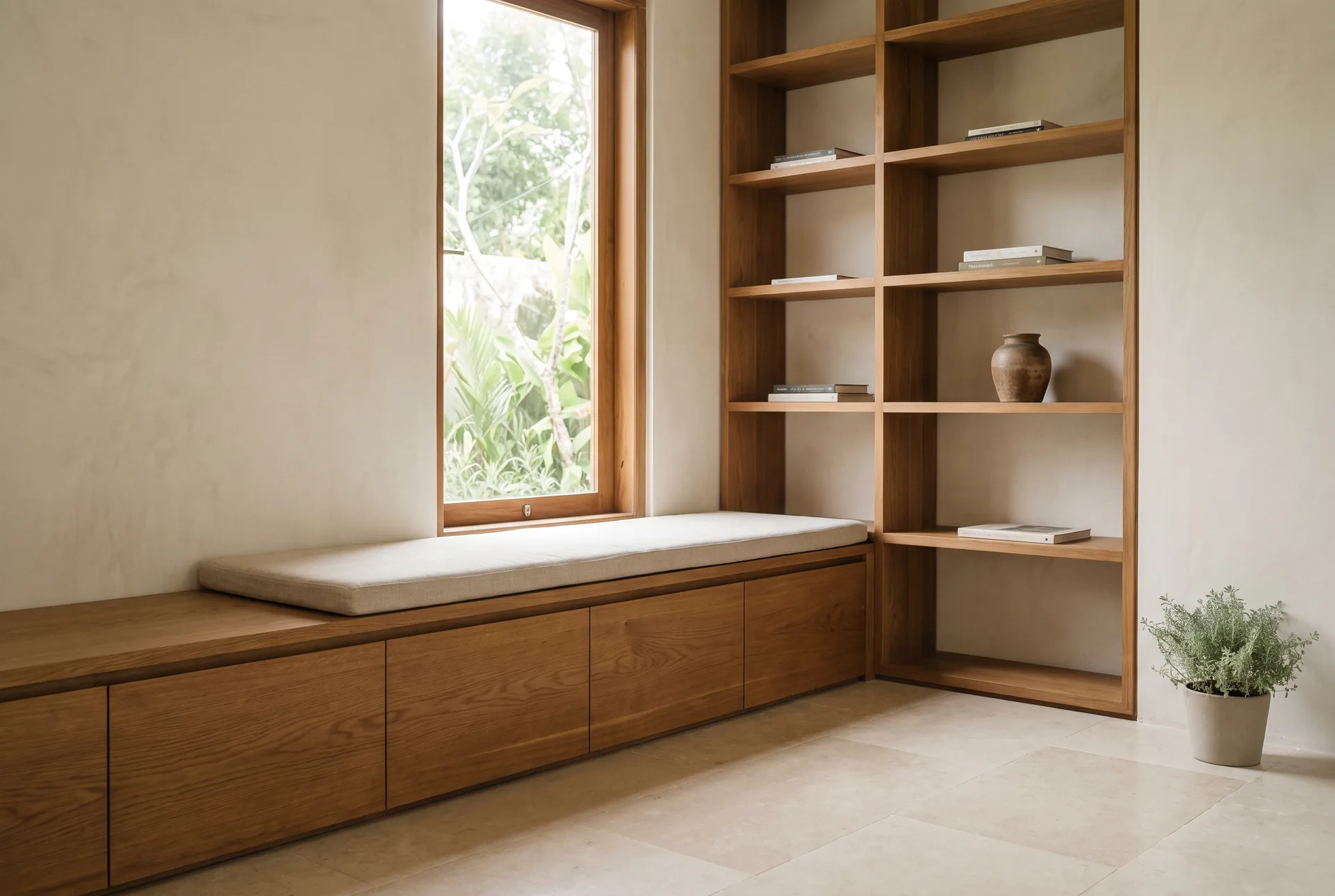
Custom furniture & carpentry
Made-to-measure furniture and woodwork designed and built for your space, from single pieces to full fit-outs.
Explore service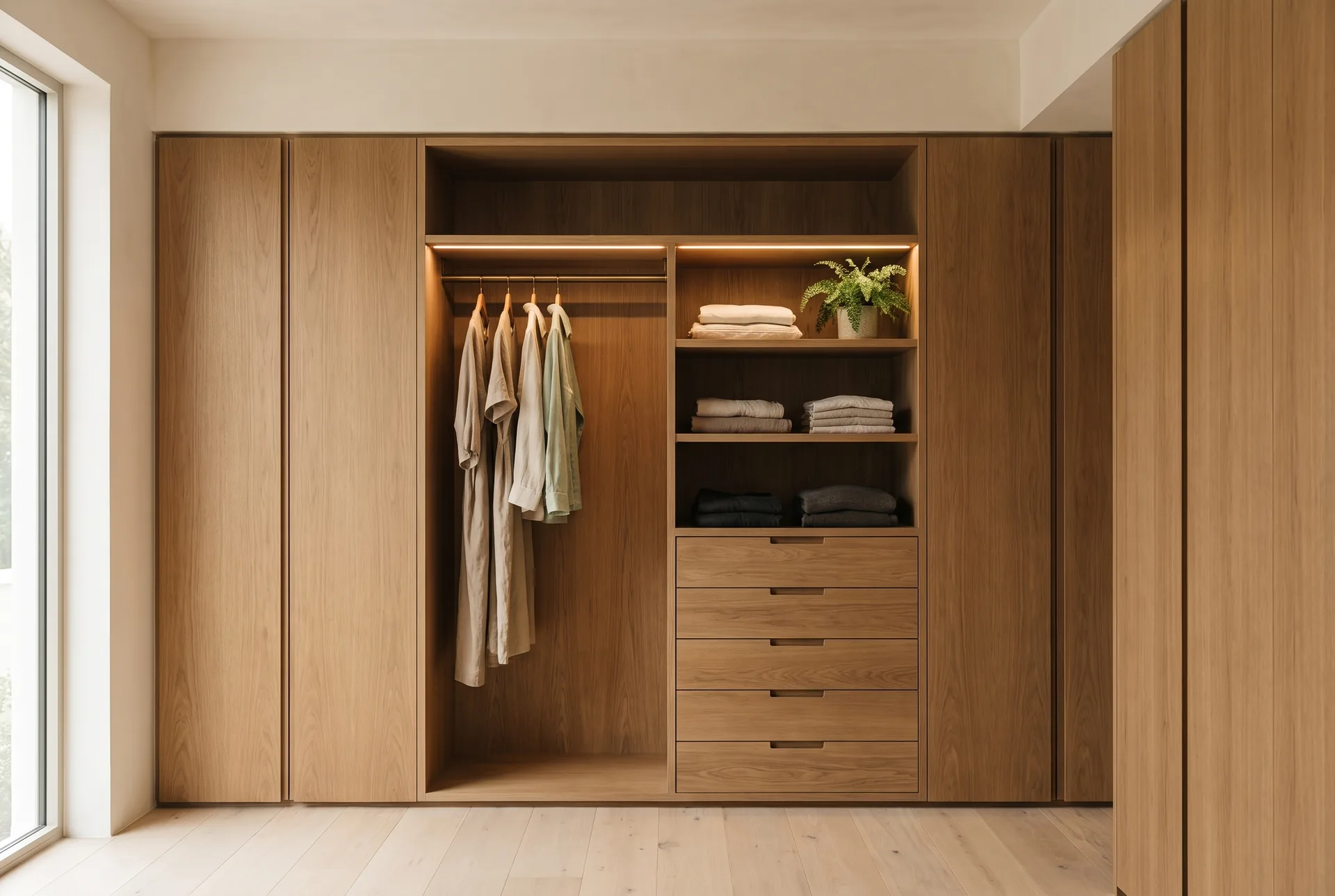
Built-in wardrobes & cabinets
Built-in wardrobes, closets and storage cabinets that use every centimetre. Measured, built, and installed.
Explore service
Tell us what you need built or installed.
Send a few photos and measurements — we'll get back to you with next steps.