
Choosing hinges, drawer runners and hardware for custom furniture
Published by Chaingkiat & Furniture — Nearly 30 years of hands-on carpentry, with our own workshop and crew on Koh Samui. · · 9 min read
"Why has the wardrobe door dropped after a year, when the wood is fine?" It is the most common question we hear about furniture somebody else made, and the answer is nearly always the same: the wood was never the problem. A cabinet is timber plus hardware, and the hardware is the part that moves ten thousand times. It is also the part that quotes hide savings in, because two hinges can look identical in a showroom and behave completely differently by the second wet season.
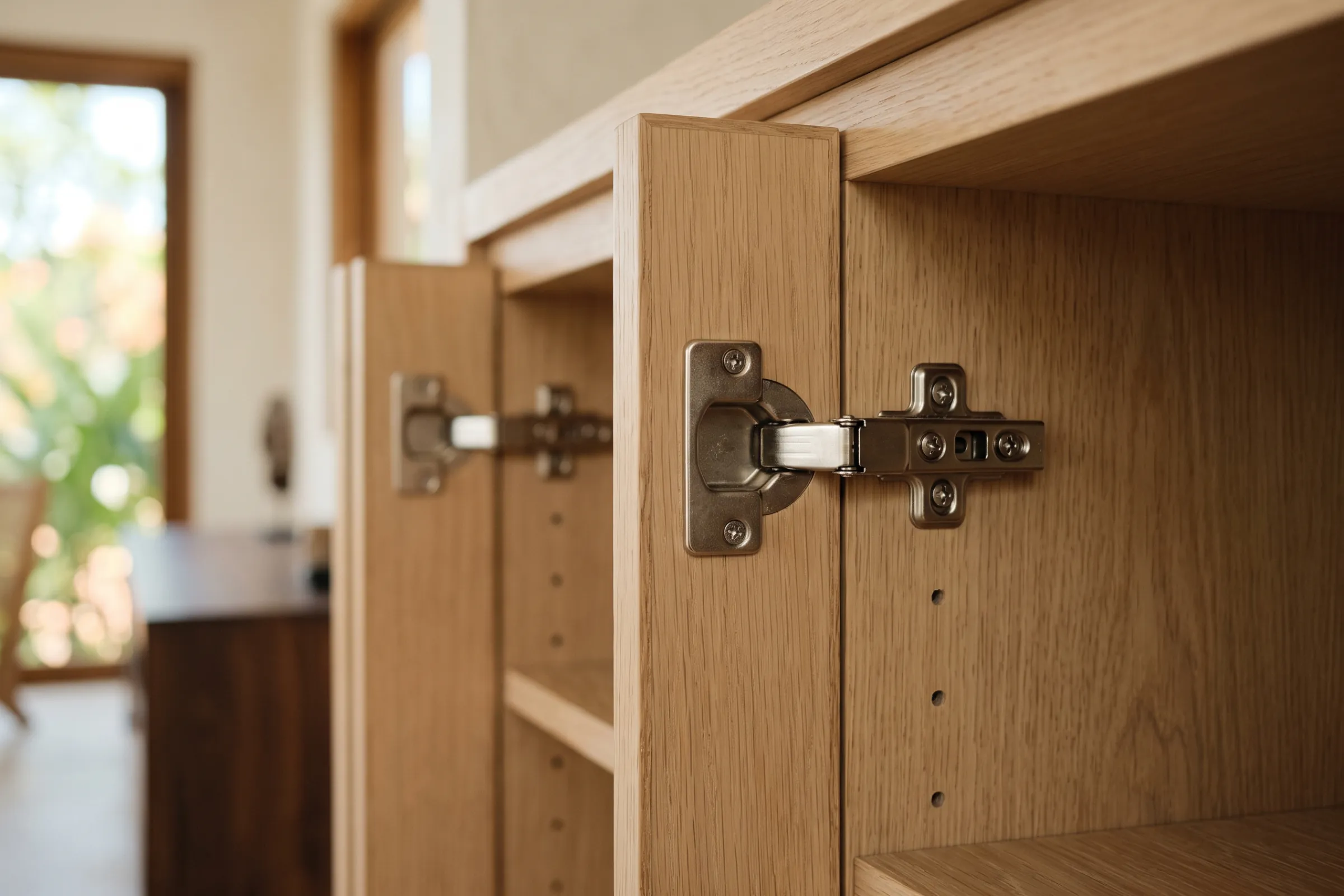
This guide is the conversation we have with clients when a drawing is nearly finished and the hardware line still says "standard". No brands, deliberately, and no single answer, because the right hinge for a hall cupboard is the wrong one for a kitchen by the sea. What follows is how each family works, what the numbers on the box mean, and how to choose for the piece in front of you.
Concealed hinges: the cup, the arm and the angle
Almost every modern cabinet door hangs on concealed cup hinges: a round cup bored into the back of the door, an arm clipped to a plate on the carcass side. Invisible when closed, adjustable when open. The cup is 35 mm in diameter on nearly everything you will be offered, which is why 35 mm is the number printed on the box and the cutter every boring jig is set up for; a handful of small or thin-door hinges use a 26 mm cup instead, and they are not interchangeable. The first choice is how the door sits. Overlay hinges put the door in front of the carcass edge, full or half overlay depending on how many doors share a side panel; inset hinges set the door flush inside the carcass opening, a finer look that demands a squarer carcass and tighter gaps. The second is opening angle: a standard hinge opens around 105 to 110 degrees, which is fine on a wardrobe but a nuisance beside a wall or in a corner unit, where 155 or 170 degree hinges let the door fold clear so drawers behind it can pull out.
Then quantity. Every manufacturer publishes a table for this, and they broadly agree: a door up to about 900 mm takes two hinges, up to 1600 mm three, up to 2000 mm four, and a 2.2 metre wardrobe door five. Weight then corrects the number upwards, so a wide door, a thick door or a solid-timber one gets more than the height alone suggests, and the count is read off the chart rather than guessed. Too few hinges is the dropped-door story from the introduction, told slowly over eighteen months.
Drawer runners: where the money shows
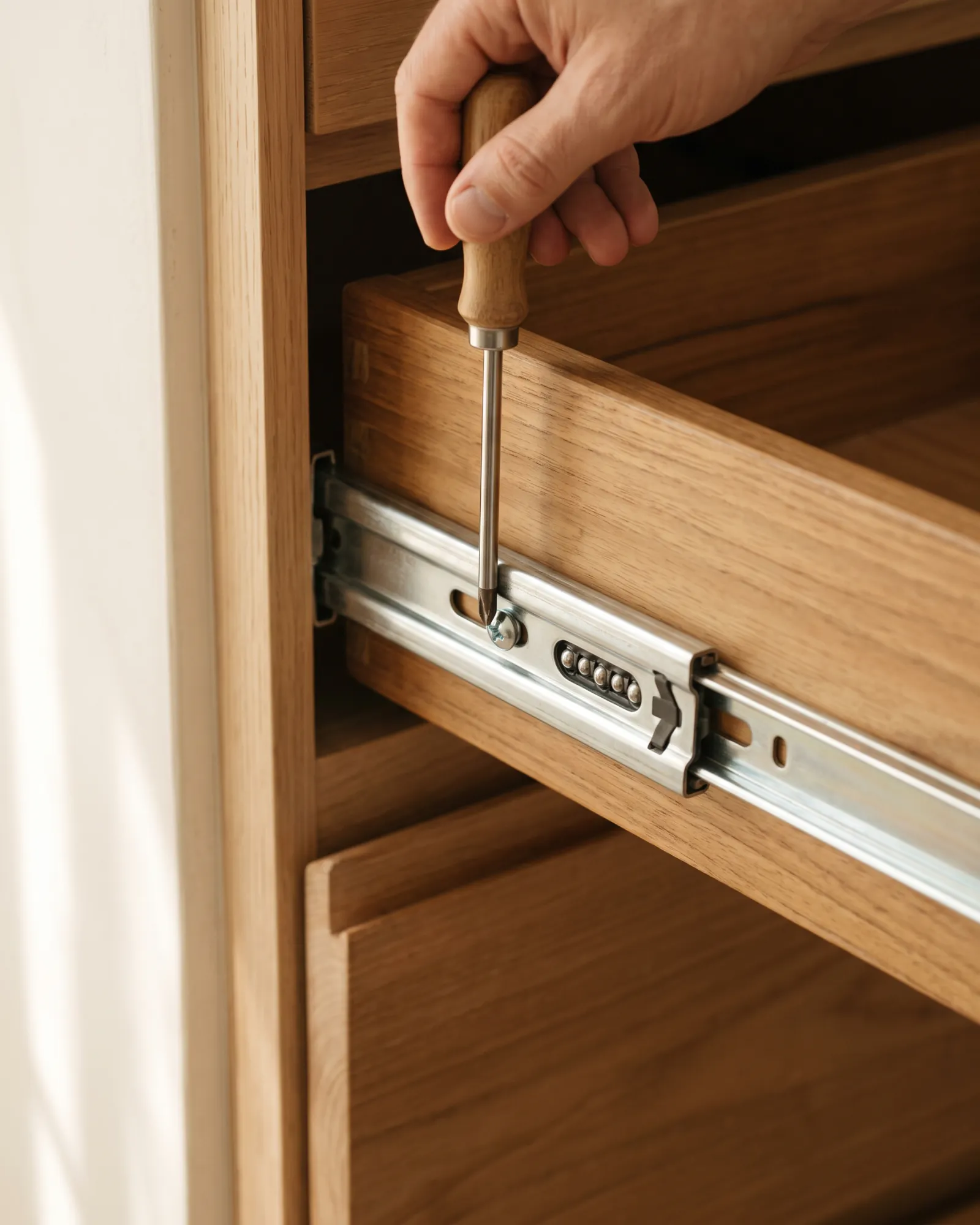
Drawer runners come in three broad families, and the difference in daily feel is bigger than the difference in price. Side-mounted roller runners are the budget tier: a plastic wheel in a steel channel, three-quarter extension, a slight rattle, a slight lean when the drawer is out. They work, and in a utility cupboard they are enough. Side-mounted ball-bearing runners are the workhorse: smooth under load, quiet, visible as a steel strip either side of the drawer box. They come in two builds, and the cheap one is common, so the distinction is worth having — a two-section runner gives three-quarter extension, a three-section runner gives full extension and reaches the back of the drawer, and "ball-bearing" on a quote tells you nothing about which of the two you are getting. Undermount concealed runners hide beneath the drawer, carry the box on its base, and give the cleanest look with the softest action, at the highest price and with the tightest tolerances in the drawer box, which is why they belong with a workshop that builds its own boxes to the millimetre.
Two numbers on the box matter. Load rating, usually stated in kilograms per pair, decides whether a drawer of pans or files still glides in five years; a 30 kg runner under a 40 kg drawer is a runner on borrowed time. Extension, three-quarter or full, decides if you ever see what is at the back. Every runner and hinge family also comes with or without a soft-close mechanism, a damper that catches the last few centimetres and settles the door or drawer silently. Soft-close is worth having on anything used daily; it is not worth much on a cupboard opened twice a year.
Wardrobe gear: rails, sliders and lift-ups
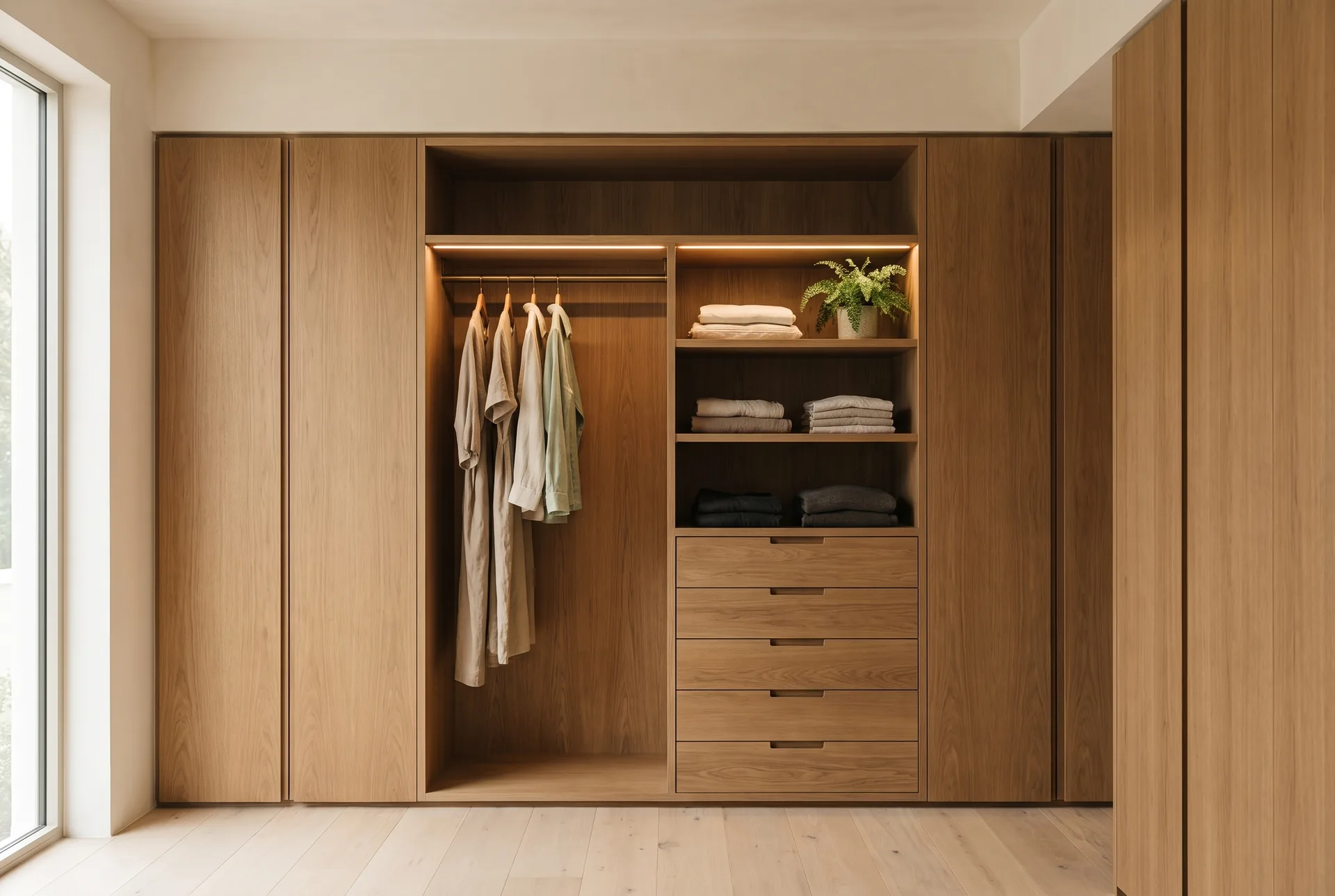
Wardrobes add hardware nothing else in the house has. Hanging rails should be oval steel section rather than round tube, and they should be fitted with the long axis of the oval running vertically, because that is the plane the rail is loaded in and depth in that plane is what resists sag; a full rail of clothes across a wide span bows a round tube visibly by year two. Long spans get a centre support whatever the section. Which door type suits the room is a separate argument, and choosing between hinged, sliding and louvred wardrobe doors belongs in the wardrobe guide; what concerns us here is the gear under each. Sliding doors run one of two ways. Top-hung gear carries the door weight on rollers in the head track, with the floor channel only keeping the door upright, so the head rail has to be fixed into something structural. Bottom-rolling gear puts the weight on wheels at floor level and uses the top track as a guide, which asks less of the ceiling and more of the floor. That is the first question a joiner asks, because it decides what carries the load and where the wear shows. After that, quality is in the parts: an extruded aluminium track rather than folded steel, sealed bearings rather than bare nylon wheels, a stated weight rating the door has to sit inside, soft-close dampers at both ends of the travel and not only at the close, and enough intermediate fixing along a long track to stop it deflecting and the doors binding on each other. Cheap gear rumbles and jumps its track, and a bedroom wardrobe is the one piece of furniture you operate before you are properly awake. Lift-up stays that hold a top cupboard door open overhead are a third family, rated by door size and weight like everything else.
Built-in wardrobes & cabinets
Built-in wardrobes, closets and storage cabinets that use every centimetre. Measured, built, and installed.
Explore serviceHandles, or no handles
The handleless look is popular for good reason and comes in two mechanical versions worth understanding. Push-to-open uses a spring catch that pops the door or drawer when pressed; it is clean and works on any front. A plain push latch and a plain soft-close damper do fight each other on the same door, because the damper's resistance stops the latch arming reliably, so what you specify is a combined push-latch-and-soft-close unit rather than two separate parts. Those are ordinary catalogue items in every hardware range, not a special order, and the mistake to avoid is buying the two functions separately and expecting them to co-operate. A J-profile or milled pull groove, a recessed finger-grip machined into or fitted to the top edge of the front, needs no mechanism at all and lives happily with soft-close, at the cost of a visible line and a slightly more complex front to make. Conventional handles remain the most reliable choice for heavy doors, for kitchens where hands are wet and greasy, and for anyone who has watched a push-to-open drawer bounce open again.
Salt air and the metal it prefers
By the coast, corrosion is the hardware question that outranks all the others. Most cabinet hardware is steel with a plating: zinc plating in the budget tiers, nickel plating or a nickel-chrome finish on better lines, and in some ranges a stainless-steel option. Zinc protects well in a dry inland room and poorly in humid, salty air, where white bloom and then rust show first on the hinge arms and runner channels. Nickel plating lasts markedly longer while it is intact, and that qualifier carries more weight than it sounds like it does. Zinc is sacrificial to steel: it sits lower in the galvanic series, so it corrodes in preference to the steel underneath and keeps protecting a scratch after the coating is broken. Nickel is cathodic to steel, the other way round, so a nickel coating that has been scratched, chipped or pin-holed turns the exposed steel in the damage into a small anode and it pits faster there than the same damage would under zinc. Coatings in a wardrobe do get scratched, by screwdrivers, by hanging rails, by the fitting itself, and salt air finds the scratch. Stainless steel sidesteps the plating question entirely, and there the grade is what you are buying: 304 is the general-purpose grade and is fine indoors and away from spray, while 316 adds molybdenum and is the grade specified for marine and coastal exposure, because it resists the chloride pitting that puts rust freckles on 304 within sight of the water. Ask the question directly: what is this hinge made of, what is it plated with, and what does the maker say about coastal use.
Corrosion resistance costs more, and it is the one hardware upgrade we never argue against on this island. A hinge that seizes takes the door edge with it when it is finally forced, and a runner that rusts scores the drawer box. Sealing the carcass and keeping the cabinet ventilated slows everything down; it does not change what the metal is. The most demanding room for all of this is the smallest one, and hinges that live in shower steam applies the same test to bathroom cabinets. Locks, pivot sets and sliding tracks sit outside this guide altogether, because door gear is a different specification entirely.
Adjustability is the feature you use most
Good hardware is built to be corrected, because the building moves, the timber settles and the installer is human. A quality concealed hinge adjusts three ways: side to side to even the gaps, in and out to set the door flush, up and down to align the tops. Cheaper hinges offer one or two of these, and on those doors a gap that opens over time simply stays open. Runners work differently, and this is where the price tiers separate again. Side-mount runners, roller or ball-bearing, generally carry no adjusters at all: the drawer front is brought into line by how it is fixed to the box, with slotted fixing holes, packing shims behind the front, or, when it has gone badly, a fresh set of screw holes. The three-way front adjuster — height, side and tilt, on a pair of cams under the drawer — is an undermount feature, and being able to true up a whole bank of drawer fronts with a screwdriver after the boxes are in is a real part of what the extra price buys. Fitted joinery is aligned at installation and realigned at a follow-up visit once it has settled; on three-way hinges that visit takes minutes, and on one-way hinges there is often nothing to turn.
Living with it: maintenance and the long view
Hardware asks for very little: hinge screws snugged and runners brushed clear of crumbs a few times a year, a dry cloth on any metal that shows fingerprints or moisture, and a quarter-turn on an adjuster when a door drifts. The routine for keeping hinges and runners running after installation lives in the care guide rather than being repeated here.
The long view is the reason to care at all. The carcass of a wardrobe, a kitchen or a media wall planned as one piece is the cheap part of its life; the hardware is what turns it into something that opens, closes and holds for twenty years without a thought. That is why the hardware line is part of the design conversation on every fitted wardrobe we build, on kitchen cabinets built and fitted to your hardware spec, and on the drawers and doors on made-to-measure pieces, and why it is worth reading a quote's hardware line as carefully as its timber line. The fitted kitchens with their doors and drawers in place in our portfolio are held together by exactly these decisions, and not one of them is visible in the photographs.
Related guides
- Kitchen assembly & installation
How to care for wooden kitchen cabinets in a humid climate
How to care for wooden kitchen cabinets in a humid climate: grease and steam cleaning, sink-zone checks, ventilation habits, and swollen-edge warning signs.Read the guide - Built-in wardrobes & cabinets
Designing a built-in wardrobe for a tropical home
How to plan a built-in wardrobe for a tropical home: ventilation and mould prevention, layouts for awkward spaces, and choices that survive island humidity.Read the guide - Custom furniture & carpentry
What wood survives a humid coastal climate?
How teak, other hardwoods and modern boards cope with humidity and salt air: what swells, what lasts, and how makers choose materials for coastal homes.Read the guide
Related services
Built-in wardrobes & cabinets
Built-in wardrobes, closets and storage cabinets that use every centimetre. Measured, built, and installed.
Explore service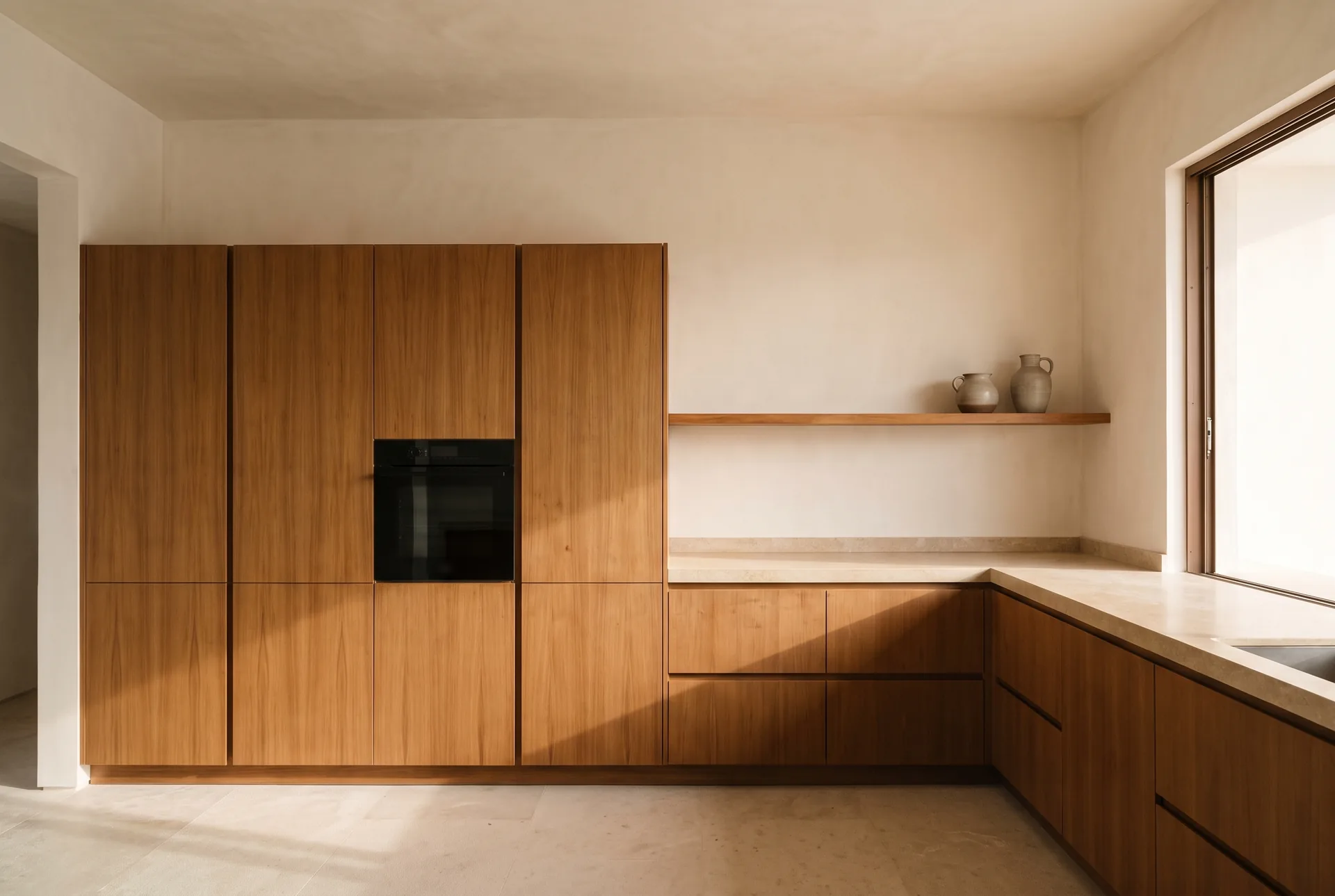
Kitchen assembly & installation
Kitchen cabinets and units assembled and installed — aligned, fixed, and finished ready for daily use.
Explore service
Custom furniture & carpentry
Made-to-measure furniture and woodwork designed and built for your space, from single pieces to full fit-outs.
Explore service
Tell us what you need built or installed.
Send a few photos and measurements — we'll get back to you with next steps.