
How to protect a wooden dining table from water, heat and daily use
Published by Chaingkiat & Furniture — Nearly 30 years of hands-on carpentry, with our own workshop and crew on Koh Samui. · · 4 min read
No piece of furniture works a harder shift than a dining table. Hot dishes, sweating glasses, homework, laptops, elbows, birthday candles: everything a household does eventually happens on the one wooden surface with nowhere to hide. Protecting it is not about wrapping it in glass. It is about knowing the handful of incidents that actually cause the damage, and what to do in the first minutes of each.
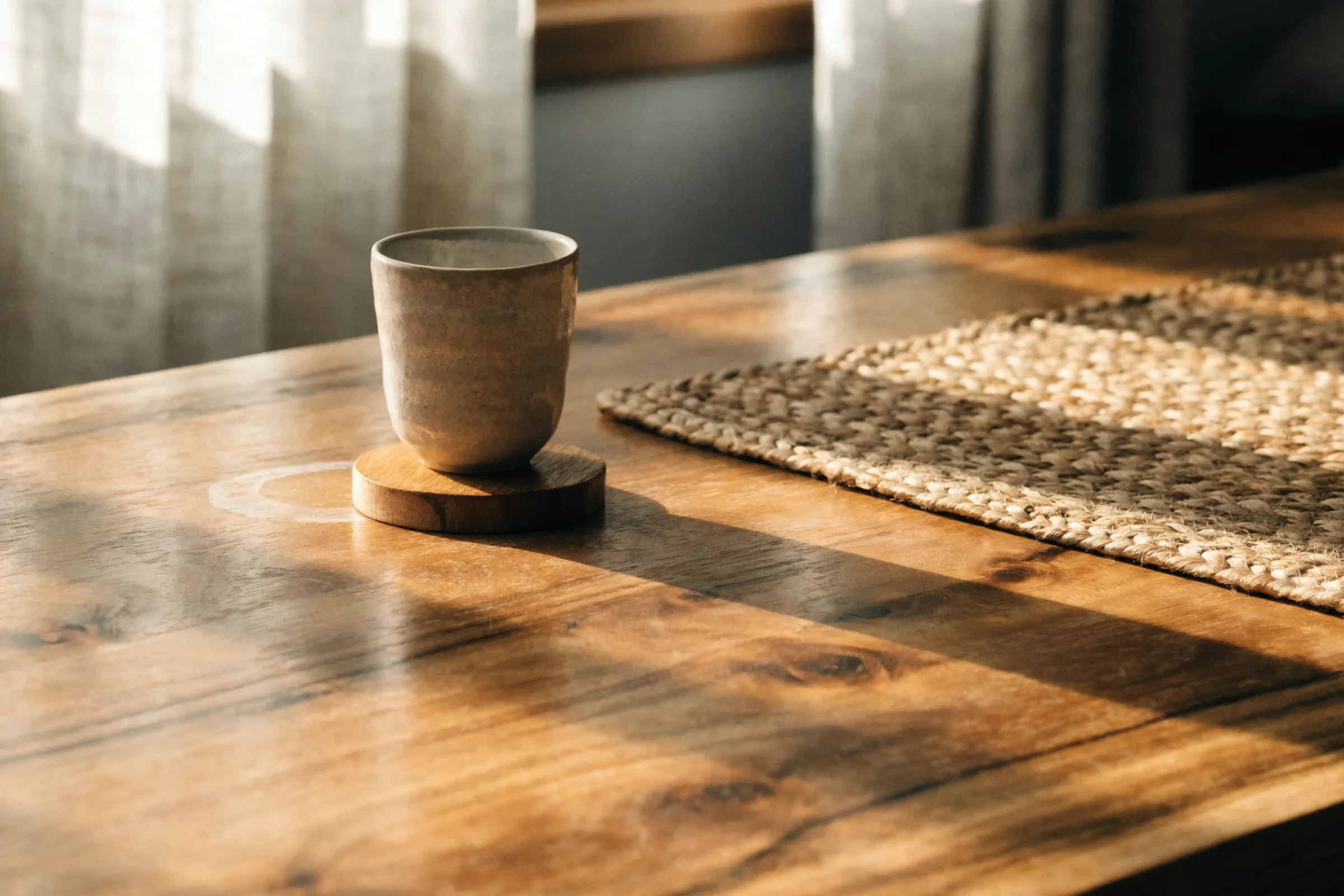
Think of this guide as the table's accident book. The incidents first, worst offenders leading, each with its first response; then the habits that stop most of them happening; and at the end, the honest question of when a well-used top has earned more than first aid. The solid teak tables from our benches are commissioned and built expecting all of it — daily use is the design brief, not the threat.
Incident one: the water ring
A cold glass sweats, the water sits, and an hour later there is a pale ghost ring on the top. White or cloudy is the better news: the moisture is trapped in the finish, not the wood. First response is simply dry and wait: wipe the area, give it warmth and air, and many fresh white rings fade over hours or days as the moisture leaves the film. Resist the internet's pantry remedies; rubbing condiments and toothpaste into a finish is abrasion with extra steps, and anything you do try should meet a hidden corner of the top first.
A dark ring or blotch is the other diagnosis: water has passed through the finish and stained the wood itself, usually because it sat overnight or found a worn patch. No wipe will lift it, and treating it properly involves working on the finish, which is a decision, not a cleaning task. Log it in the mental accident book and read the last section of this guide.
Incident two: the heat mark
A serving dish straight off the stove can print a white bloom into a film finish in under a minute; the heat drives moisture and air into the film and clouds it, in a perfect outline of the dish. Fresh, mild heat bloom sometimes settles like a water ring does, with time and gentle warmth. Deep bloom, or a mark with a scorched tint, is finish damage that first aid will not reverse. The economics are stark: the trivet costs nothing and works every time, the cure is uncertain and never free. Heat protection is one habit deep — nothing goes from flame or oven to bare wood, ever, and that includes the laptop that runs hot through a working afternoon.
The habits that empty the accident book
Almost every mark on a dining table was preventable by something that costs less than a coffee. A coaster under every glass and cup that will sweat or steam; placemats or a runner along the eating line; a trivet wherever hot dishes land. Blot a spill while it is still a spill — every finish buys minutes, none buys the evening. Cleaning is the same modest programme as all good woodcare: a soft cloth, barely damp, a little mild soap when needed, one product at a time and never combinations, dried straight after. A table cleaned this way needs no polish, and most polishes add more problems than shine.
Custom furniture & carpentry
Made-to-measure furniture and woodwork designed and built for your space, from single pieces to full fit-outs.
Explore serviceScratches, dents and the difference between them
Grit under a sliding plate scratches; a dropped bowl dents. They look similar and age differently. Fine surface scratches live in the finish, and how visible they stay depends on what that finish is — on an oiled top they blend into the patina and often disappear at the next feed, while on a film finish they catch the light until the film is renewed. A dent is compressed wood fibre, and shallow ones matter less than people fear; on a solid top they read as biography rather than damage. Prevention is the felt-and-lift rule: felt under fruit bowls and anything that lives on the table, and lifting rather than sliding whatever is heavier than a plate.
The slow incident: sunlight
A table near a bright window is being photographed by the sun, very slowly. Leave the same placemats out for a year and their outlines print into the top as the exposed wood shifts colour around them; some timbers bleach, teak tends to deepen then even out. The fixes are placement fixes: clear the table when it is not in use so it ages evenly, rotate what stays out, turn the table itself occasionally if one end lives in the light, and soften the harshest hours with a curtain. An evenly aged top is the goal — sun cannot be beaten, only made fair.
When the top has earned more than first aid
Accident books fill. A top with dark stains that cleaning cannot touch, clouding across a wide area rather than one ring, a finish worn through to bare wood at the two seats that get used daily, or a surface that feels rough and dry however it is cleaned, has moved past maintenance. That is not an emergency; it is a decision about the finish — whether to renew it, and with what — and it belongs with the guide that owns those decisions: whether a tired top is due a refinish. For damage that goes past the finish into the wood, a split, a loose joint, an edge that took real water, get an experienced opinion before anyone improvises; the sorting is in our care guide, when a table's damage is past home remedies. Either way, a solid-wood table is rarely finished as a piece of furniture just because its surface is tired. That is the point of solid wood: the story can be reset.
Related guides
- Custom furniture & carpentry
How to care for custom wood furniture: a practical maintenance guide
A practical care routine for wood furniture: cleaning that doesn't strip the finish, hardware checks, early warning signs, and when to call a carpenter.Read the guide - Custom furniture & carpentry
Oil, varnish or polyurethane? Choosing the right finish for wood
Oil, varnish or polyurethane: how each finish behaves on furniture in a humid climate, what repairs look like later, and how to choose for each surface.Read the guide - Custom furniture & carpentry
How to protect wooden furniture in a tropical climate
How to protect wooden furniture from tropical humidity: placement, airflow, finishes that seal, aircon habits, and the fixes for swelling and sticking.Read the guide
Tell us what you need built or installed.
Send a few photos and measurements — we'll get back to you with next steps.