
Wooden doors in humid weather: sticking, movement and adjustment
Published by Chaingkiat & Furniture — Nearly 30 years of hands-on carpentry, with our own workshop and crew on Koh Samui. · · 5 min read
A door is the largest moving wooden part in a house, hung to tolerances of a few millimetres, swinging through thousands of cycles a year. So when the air changes, the door is where you feel it first: the entrance leaf that needs a shoulder in October, the bathroom door that grabs its frame, the gate that drags its latch. None of it means the door was badly made. Most of it means the door is made of wood.
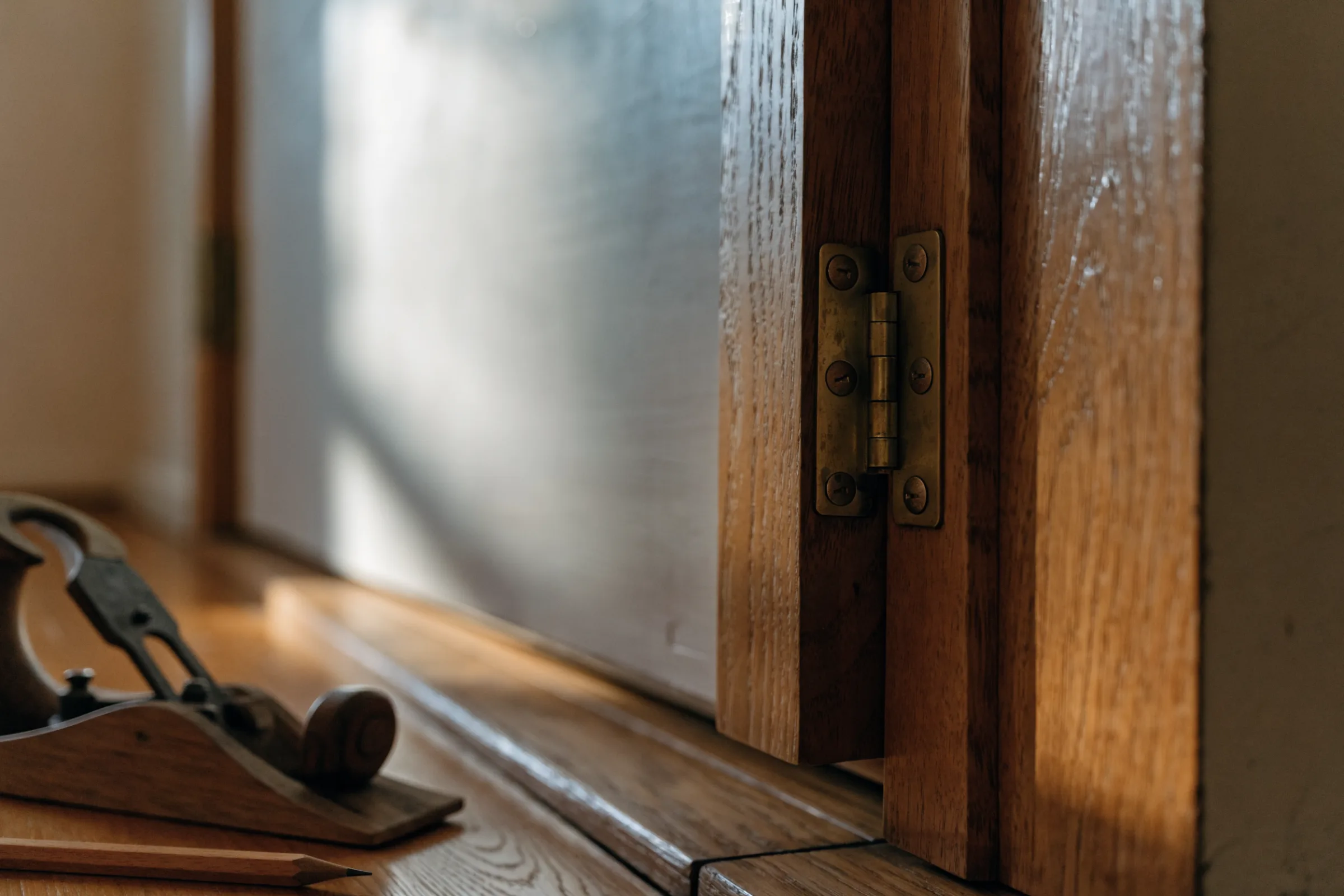
This guide answers the questions door owners actually ask, in the order they usually ask them: why now, will it pass, where exactly is it catching, what can I safely adjust, and when has weather stopped being the explanation. The answers come from the bench of a workshop that builds and hangs doors for this climate.
Why does it stick in the rains and swing free in January?
Because the leaf is wider in October than in January. Wood swells as the air's moisture rises and shrinks as it falls — the mechanism that moves every piece of wood in the house — and a door concentrates the effect: a big cross-grain width, hung in a rigid frame, with clearances measured in millimetres. A leaf swelling by even two of those millimetres has spent its whole gap.
Doors also move unevenly, which is the part that surprises people. An entrance door lives in two climates at once, sun and rain on one face, conditioned air on the other, so the faces gain and lose moisture at different rates and the leaf bows slightly toward the wetter side, then bows back. That is why the same door can rub at the top in one season, the latch edge in another, and behave perfectly in between.
Will it fix itself?
Often, yes — and this is the most useful thing to know before reaching for tools. A door that started rubbing as the rains set in, still opens and closes with a firm push, and shows no other change is almost certainly seasonal swelling, and much of it reverses when the dry months arrive. Cutting or planing that door at peak humidity builds the dry season's rattle and draught gap into it permanently; the wood you remove in October does not come back in February.
So give a mildly sticking door the season, not the plane. Ease its life meanwhile: keep the room ventilated, keep the leaf dry, do not slam it through the bind. Reserve action for doors that bind hard enough to fight daily use, and even then, start with the diagnosis below rather than the toolbox, because a good share of hard binds turn out to be hinges, not wood at all.
Where exactly is it rubbing?
Before adjusting anything, find the contact point; the door will tell you if you ask properly. Close it slowly and watch the gap line, or run a sheet of paper around the closed leaf and note where it pinches. A strip of chalk on the frame edge transfers to the leaf exactly where they meet. Then read the pattern. Rubbing along the latch edge with an even gap says general swelling. Rubbing at the top latch corner with a widening gap at the bottom hinge says the door has dropped, which is hinge wear or loose screws, not weather. Scraping along the threshold points at the bottom of the leaf or a worn hinge letting it sag. A gate dragging its latch usually means the post has moved, not the gate.
What can I adjust myself?
Hinges and strikes are fair game for a careful owner. Tighten every hinge screw first; a dropped door is very often nothing more, and if a screw spins without gripping, replacing it with a longer one of the same head size gives the thread new timber to bite. A latch that misses its strike plate by a millimetre or two is cured by loosening the plate and nudging it, or dressing its opening slightly with a file. Weatherseals count too: a door that suddenly needs a shove after new seals were fitted is compressing them, not binding, and seats in with use or a seal adjustment.
Know the boundary. Planing an edge, trimming a leaf bottom, mortising hinges deeper, or anything on a pivot door or a heavy entrance leaf sits on the other side of it — pivot hardware carries real weight through small fittings, adjusting it is precise work, and a heavy leaf taken off its hinges by one person tends to cost more than the carpenter would have. The general sorting of metal-versus-wood fixes lives in our care guide; go there when a door needs more than adjustment.
Custom wooden doors & gates
Teak entrance doors, interior doors and gates made to your opening and fitted by our crew.
Explore serviceWhat protects a door between seasons?
The door's finish is its climate suit, and its weak points are the edges you never see: the top and bottom of the leaf. Left raw, they drink moisture straight into the end grain while the faces stay sealed, which accelerates every seasonal problem on this page. When a door is repainted or re-coated, insist those edges are done; on an existing door, a mirror and a torch will tell you in a minute if yours ever were. Exterior faces have the extra enemy of sun, and an exterior coat is a wearing part, best renewed before it fails — the timing and the choice of system is the finish guide's subject, under keeping an exterior finish ahead of the sun. Beyond the finish, airflow does the quiet work: rooms and cupboards shut tight for weeks hold the damp air that feeds swelling, so a closed-up house benefits from someone opening doors as much as windows.
When it's more than weather
Some door symptoms are not seasonal and do not self-resolve. A bind that holds or worsens through a full dry season. A visible twist you can sight down the latch edge. Hinge screws that will not stay tight in enlarged, torn-out holes. Softness or dark crumbling wood at the bottom rail of an exterior door, where water has been standing on the end grain. Cracks opening along a panel line rather than hairlines in the finish. Frames that have shifted with the building itself, so the opening is no longer the shape the door was made for.
These are the door retiring from the argument, and they are worth an experienced pair of eyes rather than another season of shoulder charges. Describing the symptom and sending a photo or two is enough for any competent workshop to say what is actually involved. It is the same first step we take with our own work — the doors we've hung, from entrance leaves to driveway gates were all measured against their openings before anything was built, and that is the standard a misbehaving door deserves too. Past that point the question stops being adjustment and becomes specification, which is where the decisions that happen before a door is built begin.
Related guides
- Custom furniture & carpentry
How to protect wooden furniture in a tropical climate
How to protect wooden furniture from tropical humidity: placement, airflow, finishes that seal, aircon habits, and the fixes for swelling and sticking.Read the guide - Custom furniture & carpentry
Oil, varnish or polyurethane? Choosing the right finish for wood
Oil, varnish or polyurethane: how each finish behaves on furniture in a humid climate, what repairs look like later, and how to choose for each surface.Read the guide - Custom furniture & carpentry
How to care for custom wood furniture: a practical maintenance guide
A practical care routine for wood furniture: cleaning that doesn't strip the finish, hardware checks, early warning signs, and when to call a carpenter.Read the guide
Tell us what you need built or installed.
Send a few photos and measurements — we'll get back to you with next steps.