
Maintaining wooden ceilings, panelling and interior trim
Published by Chaingkiat & Furniture — Nearly 30 years of hands-on carpentry, with our own workshop and crew on Koh Samui. · · 5 min read
Overhead timber is the most forgotten woodwork in a house, for a flattering reason: nothing touches it. No hands, no hot pans, no sandals. A wooden ceiling can go years needing nothing at all, which is exactly why the little it does need gets missed until a small problem has had a long time to grow.
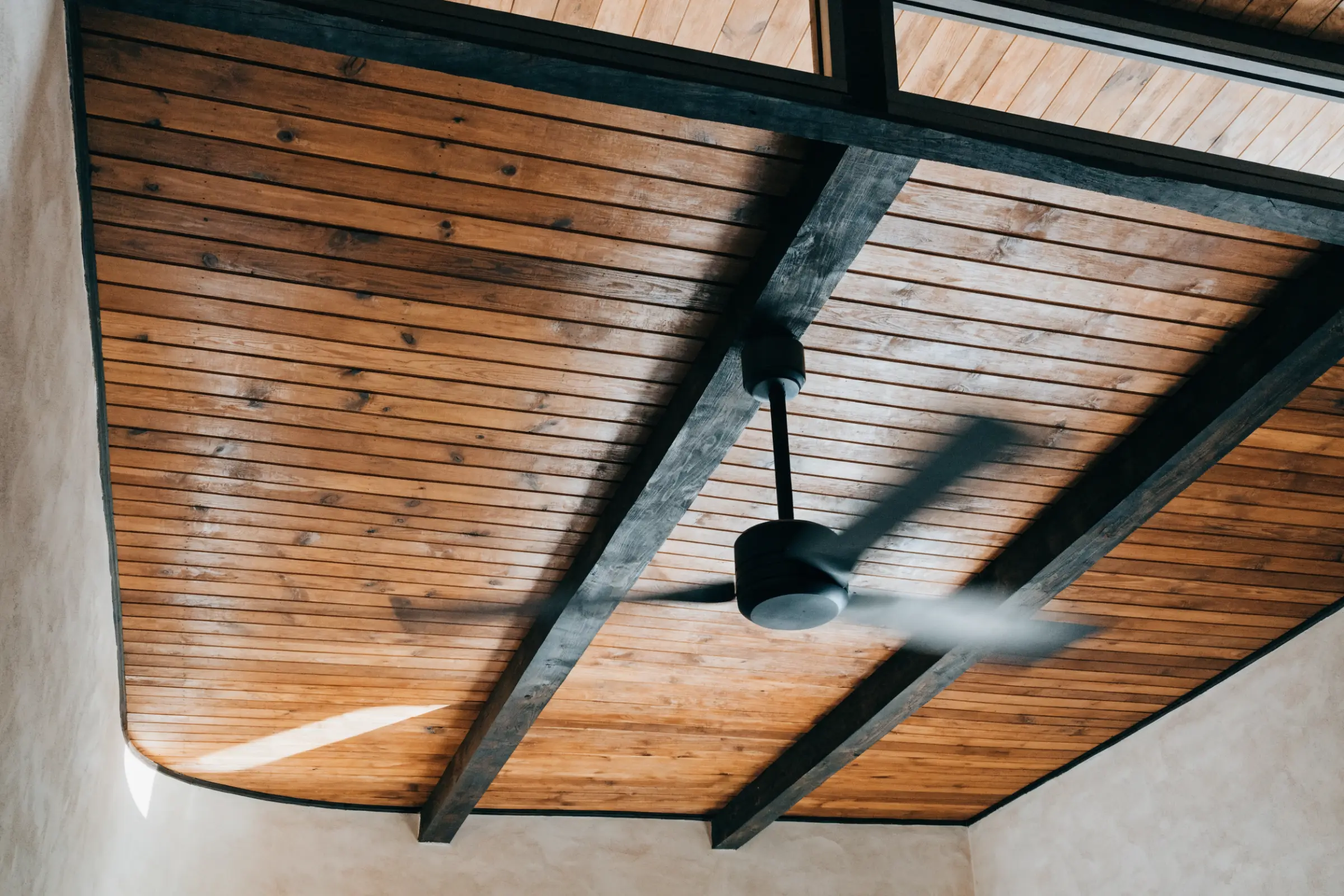
The whole discipline fits into one habit: twice a year, look up properly. This guide is that inspection, in the order a careful eye would run it — dust, stains, finish, fittings, and the small signs that mean someone else's trade needs a phone call. It applies to any timber overhead, including the ceilings and panelling our own crews install. And if the panelled wall is still a plan rather than a surface to dust, how a panelled wall is planned before it exists is the other end of this guide.
Before anything: the ladder question
Most ceiling maintenance can, and should, be done from the floor. A long-handled duster and a torch cover the routine work with both feet on the boards. Where a closer look is genuinely needed, use a proper stepladder on firm level ground with someone else in the room, and never lean out past your belt buckle. Move the ladder instead. In double-height spaces, over stairwells, and anywhere a ladder cannot stand safely, the inspection is binoculars from the floor or a professional with the right access equipment. No dust ring or dull board is worth a fall from four metres.
Dust: the only routine it asks for
The one recurring job overhead is dust, and in a tropical room with open doors there is more of it than the eye admits. It settles on the top edges of slats and battens, softens the crisp shadow lines that make a slatted ceiling worth having, and feeds every other problem by holding moisture against the wood. A microfibre duster on an extension pole, run along the boards a few times a year, is the entire treatment: along the timber, never across the slats, so the pole is not levering against fixings. Fan blades collect the thickest felt of all and shed it back into the room every season they are ignored; they get wiped, damp cloth then dry, whenever the ceiling gets its pass. No sprays, no polish overhead: anything applied up there ends up on the floor and on you.
Stains are messengers, not blemishes
A mark appearing on a ceiling board is nearly always news from above. A tan or brown ring, a dark streak following one board, a line of swollen grain along a joint: water is finding the timber from the roof space, a bathroom above, or an air-conditioning line sweating in the void. The timber is the witness, not the culprit, and cleaning the stain while ignoring its source just erases the evidence. Track the moisture back and bring in the right trade for what you find: a roofer for the roof, an air-conditioning technician for the condensate line. Only when the source is fixed and the space above is dry is it worth deciding what to do about the stained boards themselves.
Grey or black speckling in a bathroom or kitchen ceiling corner is a different messenger: condensation and still air rather than a leak. Better extraction and a door left open after showers usually starves it; the cleaning rules are the same gentle ones as everywhere else in the house.
The finish, and the heat above the lights
Ceiling finishes lead a gentle life, no wear, no water, and mostly matte systems chosen so the boards do not glare. They still age: colour slowly evens and deepens, and after enough years a finish can go flat and chalky or show hairline checking along the grain. There is no fixed schedule for renewing it; the timing depends on the system on the boards, and that question belongs to the finish guide — see how re-coat cycles differ by finish before anyone quotes you for scaffolding. What accelerates ageing locally is heat: look at the boards around downlights and any older halogen fittings for a darkened or dried ring. A scorched halo, or a fitting whose surround is hot to a careful nearby touch, is a job for an electrician, full stop — rewiring, re-lamping decisions and anything behind the fitting are not ladder-and-screwdriver territory.
Wooden ceilings & architectural woodwork
Timber ceilings and architectural woodwork that bring warmth and detail to interiors.
Explore serviceInsects: know the signs, then make the call
Wood overhead is wood, and in the tropics that means watching for the signs every timber owner here learns: fine powder appearing on the floor or on furniture below a ceiling, small round exit holes in boards or beams, pencil-width mud tunnels climbing a wall toward the roof line, or hollow-sounding timber where it used to knock solid. Any one of these earns a pest-control specialist, promptly, and nothing else — not a spray can, not a hardware-store remedy, not waiting a season to see. Identifying what the insect is and treating the building correctly is a licensed trade's job, and early calls are cheap ones. The carpentry side of the story, what happens to affected boards, comes after the specialist has done theirs.
Air, and the twice-a-year verdict
Between inspections, the ceiling's best friend is the fan hanging from it. Moving air keeps the whole overhead surface at the room's humidity instead of letting a warm damp layer sit against the boards, which matters most in rooms shut up for weeks and in high spaces where air stratifies. Run fans on low in an empty house if anything is run at all.
Then, twice a year, the verdict. Dust done, no new stains, no halos, no powder below: the ceiling asks nothing more until next time, which is the usual result and the point of checking. Anything structural — a board dropping at one end, a batten line sagging, trim pulling away from the wall, fixings backing out — goes past owner maintenance and gets an experienced eye; our care guide draws that line, when overhead timber needs professional hands. The overhead timber we've lined and handed over is all built to make that verdict boring for a very long time.
Related guides
- Wooden ceilings & architectural woodwork
Why tropical villas use wooden ceilings
Why tropical villas use wooden ceilings: heat and acoustics, timber and batten options, and what installing one over a finished interior involves.Read the guide - Custom furniture & carpentry
How to care for custom wood furniture: a practical maintenance guide
A practical care routine for wood furniture: cleaning that doesn't strip the finish, hardware checks, early warning signs, and when to call a carpenter.Read the guide - Custom furniture & carpentry
Oil, varnish or polyurethane? Choosing the right finish for wood
Oil, varnish or polyurethane: how each finish behaves on furniture in a humid climate, what repairs look like later, and how to choose for each surface.Read the guide
Tell us what you need built or installed.
Send a few photos and measurements — we'll get back to you with next steps.